Avoiding Data Leakage
The many ways information sneaks from test to train — and the one rule that stops most of them
The walk-forward and time-series CV pages both defended against one kind of leakage — temporal, training on the future. But leakage is broader and sneakier than that. It is any time information from the test set, the future, or the outcome itself contaminates the training process, and its signature is uniquely dangerous: it makes your model look better, so there is no error message, no crash, nothing to warn you — the reward is the trap. Leakage is the single biggest reason a backtest gleams and live trading bleeds. This page is the umbrella: the taxonomy of how it happens, the one discipline that prevents most of it, and a demonstration in which leakage conjures a strong, convincing signal out of pure noise.
1. What problem does it solve?
Preventing the silent inflation of measured performance that comes from letting the test set (or the future, or the target) influence training or model selection. A leaked evaluation reports a number that cannot be reproduced out of sample, so it is worse than useless — it is actively misleading. Leakage is not a single bug but a family of them, and avoiding it is the discipline that separates a backtest you can trust from one that will lose money the moment it goes live.
2. What is the core principle?
The test set must be a faithful stand-in for future, unseen data. Therefore nothing derived from it — not its labels, not its feature distribution, not any later information — may touch training or model choice. Stated as a rule: anything that learns from data (a scaler’s mean and variance, an imputer’s fill value, a feature-selection ranking, an encoder, the model itself) must be fit on the training fold only and merely applied to the test fold. Every leak is a violation of this one sentence.
3. Where does it come from?
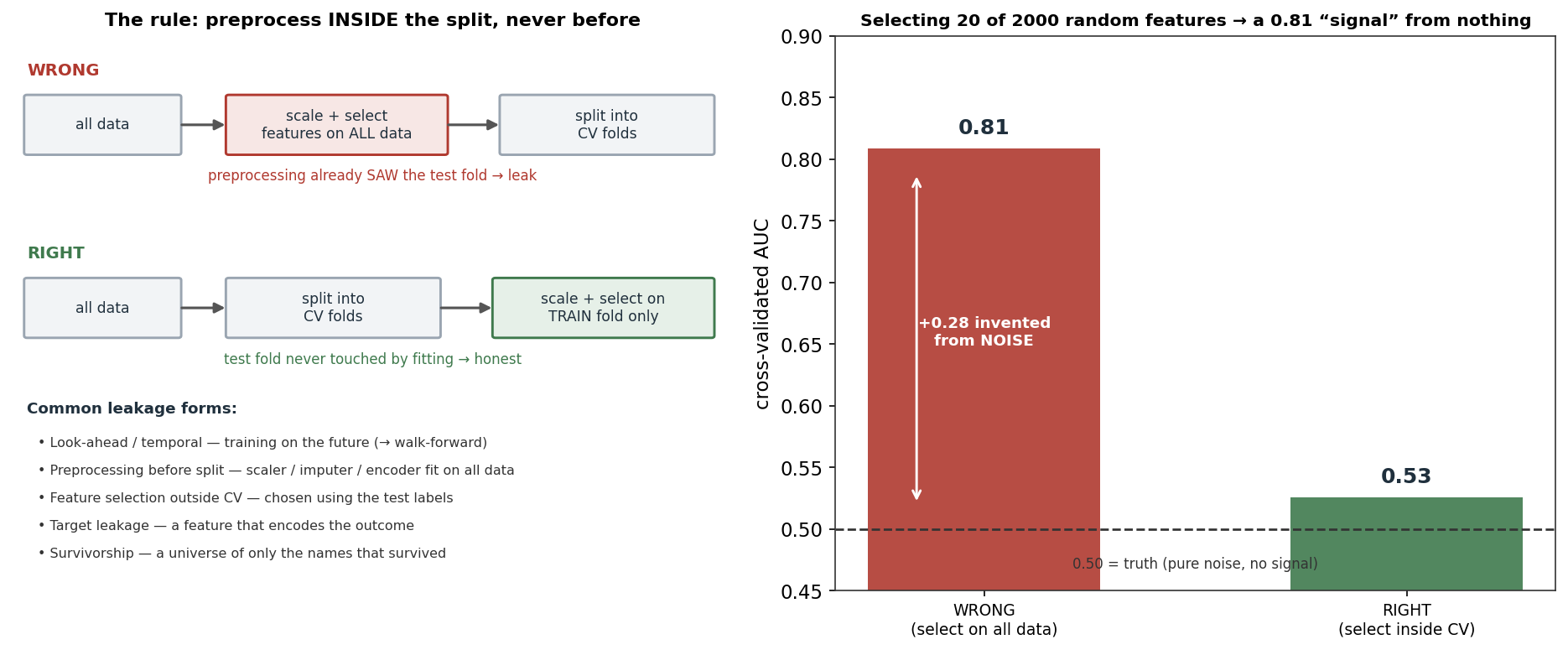
The common forms, shown in the left panel and each worth recognising on sight:
- Look-ahead / temporal — training on data from after the prediction point; the walk-forward case.
- Preprocessing before the split — fitting a scaler, imputer, encoder, or PCA on the whole dataset, so the test set’s distribution bleeds into training.
- Feature selection outside cross-validation — choosing features by their relationship to the target on all the data, so the selection has already seen the test labels.
- Target leakage — a feature that secretly encodes the outcome (a value known only after the label is determined, or same-timestamp information you wouldn’t have in real time).
- Survivorship bias — building a universe from only the names that survived, so the delisted losers are invisible and every backtest is flattered.
4. How do you prevent it?
One rule handles the majority: preprocess inside the cross-validation loop, never before it. Put every data-learning step — scaling, imputation, encoding, feature selection, the model — into a single pipeline, and pass the pipeline to the cross-validator, so it refits on each training fold and the test fold is never seen during fitting. The right panel shows why this is not pedantry. Take pure noise: 400 rows, 2,000 random features, a random binary target, no relationship whatsoever. Rank the features by their correlation with the target using all the data, keep the top 20, and cross-validate a classifier on them — it reports an AUC of 0.81. A strong, publishable-looking signal, entirely fabricated, because those 20 features were chosen precisely because they happened to correlate with the target on the same rows used to test. Move the identical selection inside the cross-validation loop, so each fold selects from its training data only, and the AUC falls to 0.53 — honestly near the 0.50 truth. The whole +0.28 was leakage: a signal invented from nothing.
Scaling before the split leaks too — it is wrong in principle, though usually small in effect (here an imperceptible 0.586 versus 0.587). The dangerous cases are the aggressive transforms: target encoding, oversampling (SMOTE) applied before the split, or imputation that uses the target — each can leak as badly as the feature-selection example above.
5. What are its strengths?
- Trustworthy estimates. A leak-free pipeline gives a performance number you can actually expect to see live.
- Catches the fabricated-signal trap. It is the only defence against the noise-to-0.81 illusion, which no amount of model tuning would reveal.
- One habit covers most cases. Wrapping everything in a pipeline and cross-validating the pipeline prevents the whole preprocessing-and-selection family at once.
- Reinforces the temporal discipline. The same instinct — fit on train, apply to test — is what makes walk-forward honest.
6. What are its weaknesses (and difficulties)?
- It is invisible. Leakage improves your score, so there is no failure to debug — you have to suspect it, which is a discipline, not a diagnostic.
- Many subtle forms. Survivorship, point-in-time data, and restated fundamentals live outside the CV mechanics entirely and need provenance knowledge to catch.
- Requires knowing label timing. You must know when each label becomes available to purge overlaps and forbid same-time features.
- A little slower. Refitting preprocessing on every fold costs compute versus doing it once (the price of honesty).
- Not sufficient alone. A perfectly leak-free pipeline can still overfit through repeated trials — the next page’s subject.
7. How could it apply to markets?
Leakage is the reason most amateur trading strategies die in production: the backtest leaked. Every form bites hard in finance — look-ahead (using the close to predict that same day’s direction), survivorship (backtesting on today’s index members, silently excluding everything that delisted), point-in-time violations (using restated fundamentals or later-revised data), and preprocessing/selection on all history exactly as demonstrated. And the demonstration is the cautionary tale every quant should carry: two thousand random features and a coin-flip target produce a 0.81 backtest AUC when the selection leaks — a “strategy” that is pure noise. For a MarketLens signal the defences are concrete: wrap every transform in a pipeline, use point-in-time data, include delisted names in the universe, forbid any feature that uses information from the label’s own period, and treat any surprisingly good backtest as guilty until proven leak-free.
8. What does the Python code look like?
from sklearn.pipeline import make_pipeline
from sklearn.preprocessing import StandardScaler
from sklearn.feature_selection import SelectKBest, f_classif
from sklearn.model_selection import cross_val_score

# WRONG — selection/scaling on all data, THEN cross-validate (leaks the test set):
# best = SelectKBest(k=20).fit(X, y)          # <-- fit on everything, incl. test folds
# cross_val_score(model, best.transform(X), y)

# RIGHT — everything inside ONE pipeline, refit on each training fold:
pipe = make_pipeline(StandardScaler(),
                     SelectKBest(f_classif, k=20),   # selection now sees train folds only
                     model)
auc = cross_val_score(pipe, X, y, cv=cv, scoring="roc_auc").mean()
The single habit — build a Pipeline and cross-validate the pipeline, never a pre-transformed X — prevents the entire preprocessing-and-selection family of leaks. For time order, combine it with TimeSeriesSplit and purging; for provenance leaks, fix the data, not the code.
9. How would I explain it to a supervisor?
“Data leakage is when information from the test set, the future, or the outcome sneaks into training, and it’s dangerous because it makes the model look better — there’s no error to catch, the good score is the symptom. The forms are look-ahead, preprocessing or feature selection fit on all the data, target leakage, and survivorship bias. The one rule that prevents most of it is to preprocess inside the cross-validation loop — put scaling, selection, and the model in a pipeline and cross-validate the pipeline, so the test fold is never seen during fitting. I showed how bad it gets: on pure noise, selecting the 20 best of 2,000 random features on all the data gives a cross-validated AUC of 0.81, versus 0.53 when the selection is done inside the loop — a 0.28 signal invented from nothing. In markets you add point-in-time data and delisted names, and you treat any backtest that looks too good as leaked until proven otherwise.”
Feature-selection leakage demonstrated on synthetic pure noise (400 samples, 2,000 i.i.d. Gaussian features, random binary target): top-20 features chosen by correlation on the full data then 5-fold CV, versus selection inside the CV pipeline (scikit-learn SelectKBest + LogisticRegression). Scaling-leak comparison on a small synthetic signal. Every number was checked.