The AMI Console
From proposal to interface — a design note on turning the Adaptive Market Intelligence architecture into a glass-box decision cockpit that a human governs.
The Adaptive Market Intelligence proposal describes a system for inferring market state and governing decisions under it. This note takes the obvious next question — what would it be like to use? — and answers it as a design rather than a promise. It sketches the interface and the stack behind it to the same standard as the rest of this site: every claim about how it behaves is one the architecture and the experiments already support.
The temptation is to picture a trading terminal with a big Execute button. That is the wrong build for this system, and getting it wrong would contradict the proposal’s central discipline. The AMI interface is not an order router. It is a glass-box decision cockpit: it makes the market-state posterior, its uncertainty, and its track record legible, then routes a proposed, risk-sized action to a human for sign-off. The model proposes; a person governs; the LLM is a measured input, never an executor.
What the interface is organised around
Four choices separate this from a conventional trading screen, and each falls out of the proposal rather than out of taste.
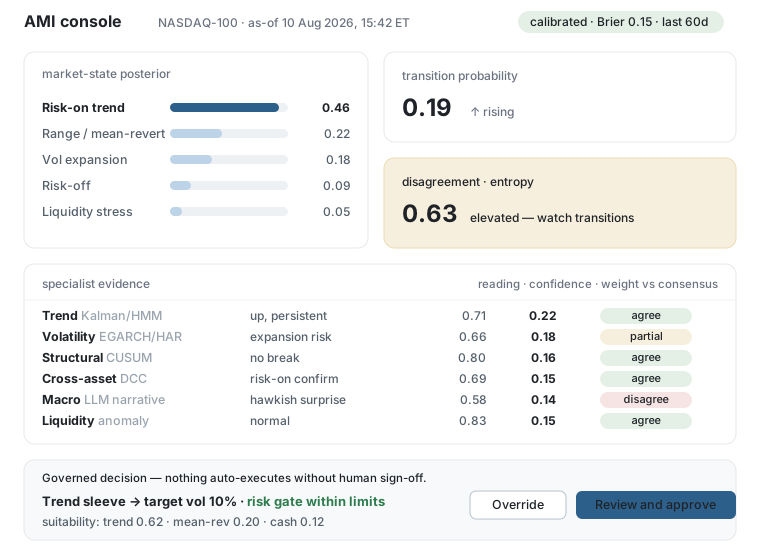
State, not price, is the centre. The hero object is the posterior over market states and its entropy; price is context. A normal terminal answers “what is the price doing?” — this one answers “what state are we in, and how sure are we?”
Disagreement is a first-class signal. The consensus layer’s own disagreement — posterior entropy — is the interface’s attention primitive, because the evidence shows the value of state information concentrates at regime transitions, exactly where disagreement spikes. When the council splits, the UI says so loudly.
Calibration is always on screen. The claim of the whole programme is calibration and risk control, not return-timing alpha. So the live calibration status — a rolling Brier score and reliability read — sits in the header as the first thing a supervisor or an allocator sees. Credibility is a permanent element, not a buried report.
Every number is traceable. No output is unexplained: each state estimate decomposes into the specialist evidence and the current reliability weights that produced it. The cockpit’s job is to let you audit the reasoning, not to be trusted on faith.
Here is the primary screen — an illustrative mock-up, not live output:
The views
The cockpit is one of a small set of screens. A specialist drill-down opens any evidence row into the underlying series, the model’s recent hit-rate, and why it currently carries the weight it does. A council view shows the competing hypotheses and how the Bayesian reconciliation combined them into the posterior and its disagreement. A strategy-and-risk view exposes the regime-conditioned suitability scores and the deterministic risk-governance constraints that gate any proposed action. A replay-and-evaluation view re-runs the system over history — walk-forward, net of costs, with deflated-Sharpe and backtest-overfitting corrections — so the calibration and transition claims can be checked rather than asserted. And a data-provenance view surfaces feeds, freshness, and available-at timestamps, because point-in-time integrity is a property to be shown, not assumed.
For a proposal, the replay-and-evaluation view is the one that matters most: it is where honest nulls and calibration are demonstrated. The cockpit impresses; the replay screen convinces.
How it’s built
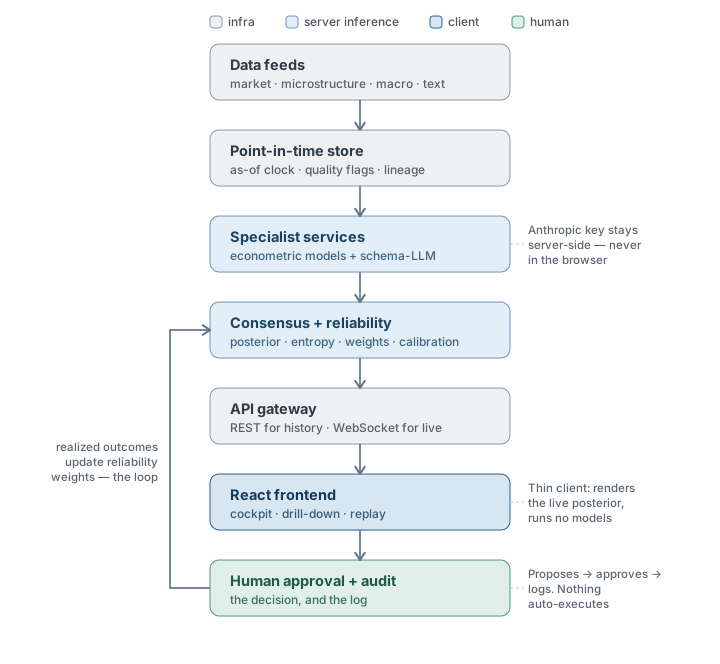
One rule shapes everything: the browser renders, the server computes. The specialists — Kalman and state-space, EGARCH and HAR-RV, cross-asset DCC, change-point and drift — and the reconciliation run server-side in Python (statsmodels, arch, filterpy), against a single as-of clock that enforces point-in-time integrity in one place. The frontend never runs a model; it subscribes to outputs over a WebSocket and renders them.
Two consequences are worth stating plainly, because both touch how I build MarketLens AI today. First, calling the Anthropic API directly from the browser has to stop for this build: it exposes the key client-side, which is tolerable for a personal tool and disqualifying for anything that governs capital. The schema-constrained LLM specialist runs server-side and returns validated JSON; the browser only ever sees the parsed evidence object. Second, the human-in-the-loop is not decoration — every proposed action, approval, and override is written to an immutable audit log, which is at once the governance record and the raw material for the outcome-review loop that updates the reliability weights.
Sequencing, and a caveat
I would build this in four passes, cheapest-credible-thing first: a read-only cockpit over the existing NASDAQ-100 prototype data; then live specialist drill-downs over a WebSocket; then the governed decision bar with its audit log; then the replay-and-evaluation view. Wherever possible I would work replay-first over stored history rather than live — it needs no streaming infrastructure, is fully reproducible, and is the honest framing for research, with “live” a later switch on the same API.
The caveat is deliberate. This interface is a demonstration and monitoring layer, not the research contribution. The contribution is the econometrics and the honest evaluation; the UI exists to make that work legible and governable, and should be built lean enough that it never competes with the science for attention — which is, in miniature, the same discipline the whole proposal argues for.