Activation Functions
The nonlinearity that makes depth work — and why ReLU unlocked deep learning
The neural network page made one claim it left unproven: the nonlinear activation is “what makes it work — without it, a stack of linear layers collapses into a single linear map.” This page is about that function. It is a small choice with outsized consequences: the activation is simultaneously the reason a deep network can represent complex functions and, for the wrong choice, the reason it won’t train at all. The history of deep learning is in large part the story of one activation — sigmoid — quietly strangling gradients for two decades, and another — ReLU — setting them free.
1. What problem does it solve?
It supplies the nonlinearity a network needs to be more than a linear model. The proof is one line: a linear layer computes W x; stack two and you get W_2(W_1 x) = (W_2 W_1)x, which is just another linear map. Without a nonlinear function between layers, any depth collapses to a single linear transformation — no amount of stacking buys expressiveness. Insert a nonlinearity between each layer and the composition can bend into arbitrary shapes (the universal approximation theorem). A second, separate job belongs to the output activation, which shapes the final prediction to the task: a sigmoid for a probability, a softmax for a class distribution, or nothing (linear) for a real-valued target.
2. What does a good activation need to be?
Five properties, usually in tension. It must be nonlinear (or the layers collapse) and differentiable almost everywhere (backpropagation needs a gradient). It should be cheap — it’s evaluated billions of times — and, ideally, non-saturating (its derivative shouldn’t vanish for large inputs) and zero-centred (so gradients don’t all share a sign). Sigmoid satisfies the first two and fails the last two; ReLU sacrifices smoothness and zero-centring to nail cheapness and non-saturation. There is no free lunch, only trade-offs.
3. Where is each one used?
Position decides. In hidden layers, the modern default is ReLU (or a variant — leaky ReLU, ELU, GELU), because it trains deep stacks reliably; tanh survives in some recurrent architectures. In the output layer, the activation is dictated by the task and its loss: sigmoid for binary classification (with binary cross-entropy), softmax for multi-class (with categorical cross-entropy), and identity/linear for regression. Choosing a hidden-layer activation is about trainability; choosing the output activation is about matching the prediction to the problem.
4. How does it work?
The intuition lives in the derivative, because backpropagation multiplies by it at every layer. Consider the three classics and their slopes:
\sigma'(z) = \sigma(z)\,(1-\sigma(z)) \le 0.25,\qquad \tanh'(z) = 1-\tanh^2(z)\le 1,\qquad \mathrm{ReLU}'(z) = \begin{cases}1 & z>0\\ 0 & z<0\end{cases}.
Sigmoid’s derivative peaks at just 0.25 (at z=0) and decays toward zero in both tails — at z=4 it is already 0.018. This is saturation: once a neuron’s input is even moderately large, its output flattens and its gradient nearly vanishes. Now recall that backpropagation sends the gradient backwards by multiplying by each layer’s activation derivative. Chain L sigmoid layers and the gradient reaching the first is scaled by at most 0.25^L — for ten layers, 0.25^{10}\approx 9.5\times10^{-7}, a millionfold shrink in the best case, and far worse once units saturate. This is the vanishing gradient problem, and it is not hypothetical: in a 15-layer network the gradient arriving at the input layer measures about 2\times10^{-11} for sigmoid — the early layers are effectively frozen and never learn.
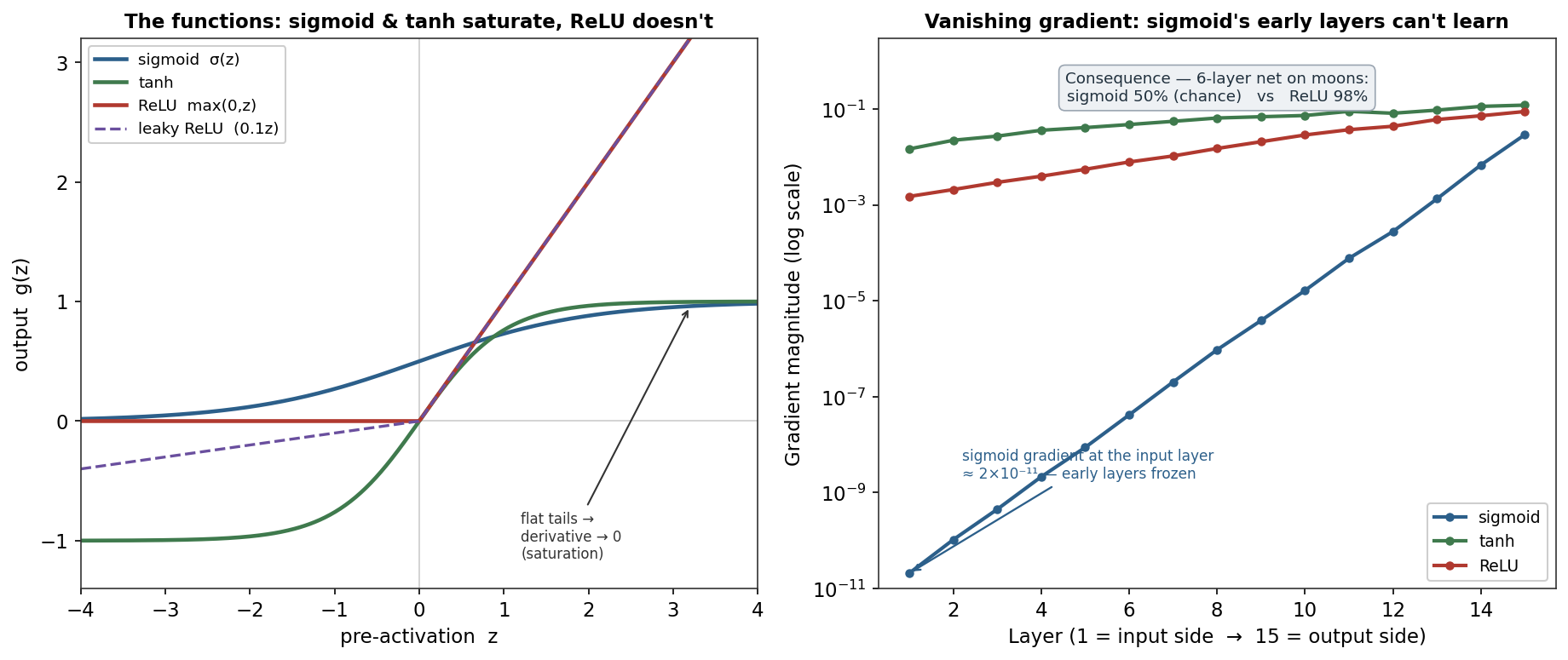
ReLU breaks the curse. Its derivative is exactly 1 wherever the unit is active, so gradients pass backward undiminished — no shrink factor, no saturation on the positive side. That single change is what made training deep networks practical. tanh is a partial fix (its derivative reaches 1 and it is zero-centred, so it decays more gently than sigmoid), but it still saturates. ReLU’s own flaw is the mirror image: for negative inputs its gradient is 0, so a unit that gets pushed permanently negative stops learning entirely — the “dying ReLU” — which is exactly what leaky ReLU (a small negative slope, 0.1z above) and ELU/GELU are designed to prevent.
5. What are its strengths?
- Non-saturating (ReLU). A derivative of 1 on the active side keeps gradients alive through many layers — the key to trainable depth.
- Cheap. ReLU is a single
max; even sigmoid/tanh are inexpensive. This matters at billions of evaluations. - Enables universal approximation. Any of them, inserted between linear layers, gives the network its nonlinear expressiveness.
- Task-shaping outputs. Sigmoid and softmax turn raw scores into calibrated probabilities that pair cleanly with cross-entropy.
- Sparsity (ReLU). Zeroing negative activations yields sparse, often more robust representations.
6. What are its weaknesses?
- Vanishing gradients (sigmoid, tanh). Saturating derivatives throttle learning in deep stacks — the historical roadblock.
- Dying ReLU. Units stuck in the negative region have zero gradient and never recover (mitigated by leaky ReLU/ELU/GELU).
- Not zero-centred (sigmoid). All-positive outputs bias the gradient signal, slowing convergence.
- No universal best. The right choice depends on depth, architecture, and layer position — it’s an empirical decision.
- Output/loss must match. A softmax output demands cross-entropy, not squared error; mismatches train badly.
7. How could it apply to markets?
Here the activation choice is about trainability, not signal — it won’t conjure predictability that isn’t there, but the wrong choice stops a model learning even the structure that is. For a market network you’d use a sigmoid output for an up/down probability, a softmax output for a regime classifier (calm / sell-off / rally), or a linear output for a volatility magnitude — and ReLU in the hidden layers so that a deep model actually trains rather than freezing on vanished gradients. The volatility model that reached 0.57 AUC would, built deep with sigmoids, simply fail to train — not because the signal vanished, but because the gradient did. The efficient-market verdict is unchanged; the activation just determines whether the network can reach it.
8. What does the Python code look like?
import numpy as np

def sigmoid(z): return 1 / (1 + np.exp(-z))     # output: probability  (with BCE loss)
def relu(z):    return np.maximum(0, z)          # hidden default: non-saturating
def leaky(z, a=0.01): return np.where(z > 0, z, a * z)   # fixes "dying ReLU"

# derivatives — what backprop multiplies by at each layer
d_sigmoid = lambda z: sigmoid(z) * (1 - sigmoid(z))      # <= 0.25  -> vanishes in depth
d_relu    = lambda z: (z > 0).astype(float)              # 1 or 0   -> gradients survive
In a framework you just name it: MLPClassifier(activation="relu") in scikit-learn, or nn.ReLU() / nn.GELU() between linear layers in PyTorch. The output activation is usually implicit in the loss — BCEWithLogitsLoss and CrossEntropyLoss apply sigmoid and softmax internally for numerical stability, so you feed them raw logits.
9. How would I explain it to a supervisor?
“The activation function is the nonlinearity between layers — without it a deep network is algebraically just one linear layer, so it’s what makes depth mean anything. The subtlety is in the derivative, because backprop multiplies by it layer after layer. Sigmoid’s derivative maxes at 0.25 and saturates to zero, so across many layers the gradient shrinks like 0.25 to the power of the depth — in a 15-layer net the input-layer gradient is around 1e-11 and the early layers never learn. That’s the vanishing-gradient problem that stalled deep learning, and ReLU fixed it: its derivative is 1 for active units, so gradients pass through. I showed it directly — a six-layer network gets 50%, pure chance, with sigmoid but 98% with ReLU. So ReLU (or a variant) in the hidden layers, and the output activation matched to the task: sigmoid for probabilities, softmax for classes, linear for regression.”
Derivative bounds are exact; the per-layer gradient magnitudes come from a 15-layer, width-64 network with identical initialisation across activations, so the difference is the activation alone. The deep-network moons comparison uses scikit-learn MLPClassifier (six hidden layers) with logistic versus relu. All figures were computed and checked.