Attention
Content-based retrieval — the mechanism, the √d scaling, and self vs cross
The transformer page used self-attention as a black box: “every position attends to every other.” This page opens the box. Attention is a general mechanism, older than the transformer — it began as a fix for recurrent translation models, letting a decoder look back at an entire source sentence instead of a single compressed vector — and it is worth understanding on its own terms. At heart it is a differentiable, content-based retrieval: a query pulls information from wherever it is relevant, weighted by learned similarity. Understanding three things — the scaled dot-product, the reason for that mysterious \sqrt{d}, and the split between self- and cross-attention — is understanding most of modern deep learning’s core.
1. What problem does it solve?
The “look anywhere” problem: letting a model draw on the most relevant parts of its input rather than forcing everything through a fixed-size bottleneck. It was born solving exactly that — early recurrent sequence-to-sequence translators crushed a whole sentence into one hidden vector and choked on long inputs; attention let the decoder access all the encoder’s positions and focus on the relevant ones. Generalised, it is content-based, differentiable information retrieval: a learnable way to fetch and blend information by relevance.
2. What assumptions does it make?
That relevance can be measured by a learned similarity — specifically the dot product between a query and a key — and that a soft, weighted average of values is a sensible way to aggregate what was retrieved. Implicitly it assumes the representations are rich enough that dot-product similarity means something useful, and (because attention alone is order-blind) that any needed notion of position is supplied separately.
3. Where is it used?
Anywhere dynamic, content-based routing helps. Within a sequence (self-attention — relate each element to the others), between two sequences (cross-attention — translation, retrieval, multimodal models), or over an external memory. It is not tied to a data type; it is a building block that appears in transformers, in older RNN translators, in retrieval systems, and in vision/audio models alike.
4. How does it work?
Three roles per element: a query (what am I looking for), a key (what do I offer), and a value (what I hand over if chosen). The attention weight from a query q to each key k_j is the scaled dot product passed through a softmax, and the output is the weight-blended sum of values:
\text{Attention}(q,K,V) = \sum_j \text{softmax}_j\!\Big(\tfrac{q\cdot k_j}{\sqrt{d}}\Big)\,v_j.
It is a soft dictionary lookup: a hard lookup returns the one value whose key matches the query; attention returns a similarity-weighted blend of all values. The right panel works an example — a query aligned with the first key retrieves mostly its value (weight 0.39) while an orthogonal key contributes least (0.14), producing a blended output.
Why the \sqrt{d}? This is the detail the transformer page skipped, and it matters. The dot product of two d-dimensional vectors is a sum of d terms, so its variance grows with d and its standard deviation grows as \sqrt{d}. Feed those ever-larger scores into a softmax and it saturates — collapsing onto a single key, nearly one-hot — and a saturated softmax has almost no gradient (its slope is p(1-p), which vanishes as p\to 1). The left panel measures it: with no scaling, the mean top attention weight climbs from 0.37 to 0.93 as d grows from 2 to 256 (attention freezing onto one key) and the softmax gradient shrinks about 7-fold; dividing by \sqrt{d} normalises the score variance back to ~1, so the attention distribution and its gradients stay healthy at any dimension. It is a one-symbol fix for a real training pathology.
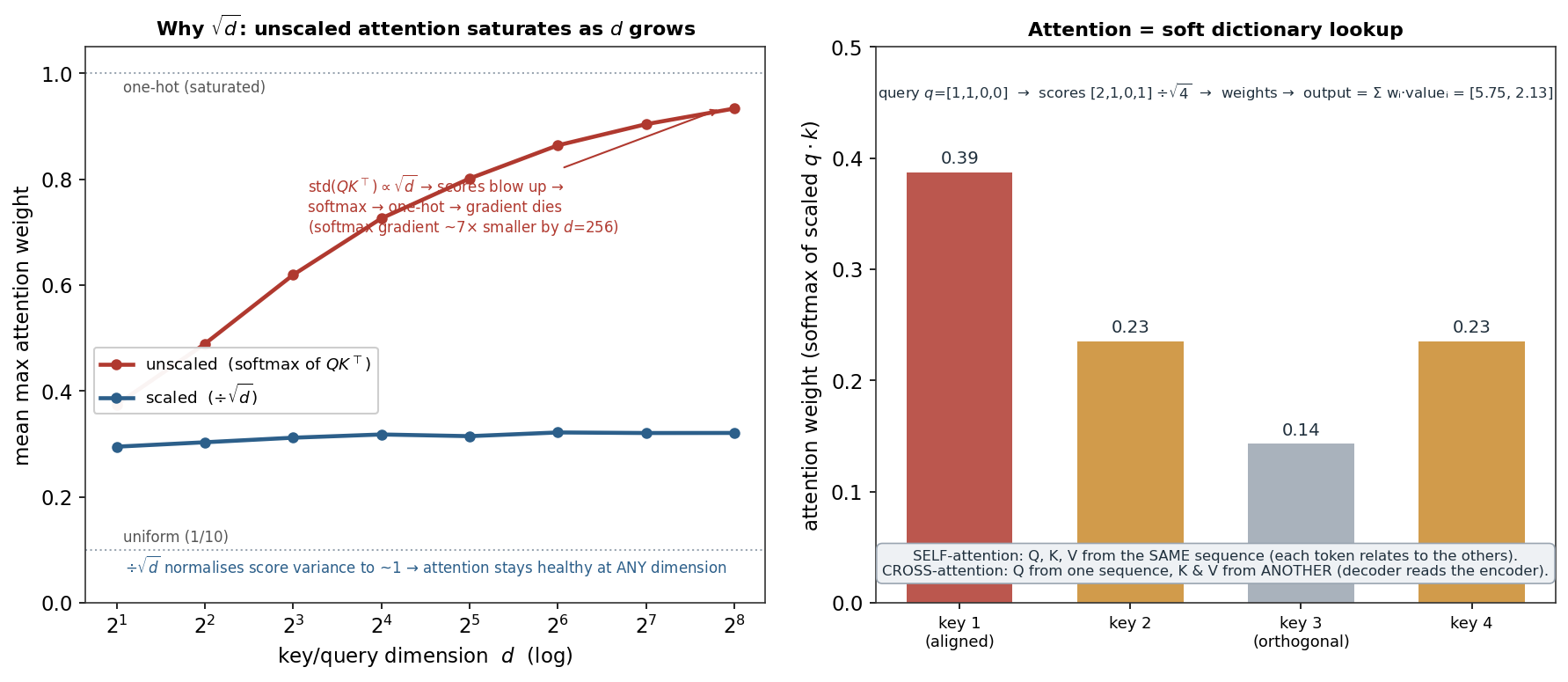
Two elaborations complete the picture. Multi-head attention runs several attention operations in parallel on different learned projections of the same inputs and concatenates them — each head specialises in a different kind of relationship (one might track syntax, another long-range reference). And the self- vs cross- distinction is simply where the three roles come from: in self-attention the queries, keys, and values are all projections of the same sequence (each token relates to its context); in cross-attention the queries come from one sequence and the keys and values from another (a decoder querying an encoder — the original translation use).
5. What are its strengths?
- Dynamic, content-based routing. It draws from wherever is relevant, decided per input, not from a fixed window or position.
- Differentiable retrieval. The whole lookup is learned end-to-end by gradient descent.
- Long-range and variable-length. Any position is directly accessible, regardless of distance or sequence length.
- Interpretable. The attention weights show what each query drew on.
- A universal building block. Self, cross, and multi-head variants compose into almost every modern architecture.
6. What are its weaknesses?
- Quadratic cost. Every query scores every key — O(n^2) — expensive for long sequences.
- Needs the \sqrt{d} (and normalisation). Without careful scaling it saturates and stops learning, as above.
- Order-blind. Attention is permutation-invariant; sequence order must be injected separately.
- Correlational, not causal. Attention weights show where the model looked, not why it decided — a caveat for interpretation.
- Blur. A soft average can smear information when a sharp, discrete choice would be better.
7. How could it apply to markets?
Attention lets a model decide, dynamically, which inputs matter for a given prediction — which past days, which peer assets, which features — rather than weighting them all fixedly. The honest caveat is the one the transformer already delivered: on a plain Nasdaq return series the learned attention comes out diffuse and the verdict is unchanged (volatility ≈ 0.56, direction ≈ 0.50), because there is no exploitable relevance structure in signed returns to route. But the mechanism is genuinely useful in quant work where such structure exists — cross-attention across a cross-section of assets (which peers inform this one’s move), attention over news or filings tied to a ticker, or as an interpretable attribution layer showing which features a signal leaned on. The mechanism is sound and general; it simply cannot attend to a relevance that the market does not contain.
8. What does the Python code look like?
import numpy as np

def attention(Q, K, V):                       # Q:(nq,d)  K,V:(nk,d)
    d = Q.shape[-1]
    scores = Q @ K.T / np.sqrt(d)             # the sqrt(d) is not optional
    W = np.exp(scores - scores.max(-1, keepdims=True))
    W /= W.sum(-1, keepdims=True)             # softmax over keys
    return W @ V, W                            # blended values, and the attention weights

# self-attention: Q, K, V are projections of the SAME sequence X
# cross-attention: Q from X (decoder), K and V from Y (encoder)
# multi-head: split d into h heads, attend in parallel, concatenate
In frameworks this is torch.nn.functional.scaled_dot_product_attention or nn.MultiheadAttention; the essential lines are the \sqrt{d} scaling and the softmax over keys.
9. How would I explain it to a supervisor?
“Attention is a differentiable dictionary lookup: a query is compared to a set of keys by scaled dot product, softmaxed into weights, and used to take a weighted average of the corresponding values — so a model retrieves information by content rather than by fixed position. The \sqrt{d} scaling is essential: dot products grow like \sqrt{d} with dimension, and without dividing them down the softmax saturates to one-hot and its gradient dies — I measured the top weight hitting 0.93 and the gradient dropping about sevenfold by 256 dimensions, both fixed by the scaling. Multi-head runs several in parallel for different relationships, and it’s self-attention when query, key, and value come from one sequence, cross-attention when the query reads a different one. On plain return series the learned attention is diffuse and adds nothing, but for routing across assets or over text it’s a genuinely useful, interpretable mechanism.”
The \sqrt{d} saturation curves are Monte Carlo over random unit-Gaussian queries and keys (10 keys, 3,000 trials per dimension), measuring mean maximum attention weight and the softmax gradient proxy p(1-p) with and without \sqrt{d} scaling. The worked retrieval example is exact. This page is the mechanism companion to the transformer entry. Every number was checked.