CUSUM & Concept-Drift Detection
The cheap, online tripwire for a changed distribution — and the average-run-length trade-off that governs every change detector
The change-point entry built a Bayesian detector — BOCPD, which carries a full posterior over how long the current regime has lasted. That richness costs compute. This entry builds its frequentist, lightweight complement: CUSUM, a one-line recursion that accumulates evidence of a shift and trips an alarm, with an explicit, tunable false-alarm rate. It is the always-on tripwire a real-time system wants alongside the considered posterior — and its operating characteristic teaches the single most important fact about any change detector: you cannot have both instant detection and no false alarms. For the proposal’s structural-change specialist, CUSUM is the cheap, low-latency alarm; BOCPD is the second opinion.
1. What problem does it solve?
Noticing that the distribution changed — fast, online, and with a controllable false-alarm rate. A market system runs continuously on a stream, and the most dangerous moment is the one where the process generating that stream shifts: volatility expands, a correlation breaks, a model’s error rate creeps up. You need to detect that as it happens, from a single pass over the data, cheaply enough to run on everything at once, and with a dial that sets how trigger-happy the alarm is. CUSUM does exactly this. It is the canonical sequential change detector — provably the fastest way (Lorden, Moustakides) to detect a shift of a given size for a given tolerated false-alarm rate — and the same machinery, pointed at a model’s error stream, is concept-drift detection: the signal that the world has moved and the model must be refit.
2. The CUSUM recursion
CUSUM accumulates the deviations of a stream x_t from an in-control reference \mu_0, with a slack k that it must overcome before it starts to build, and trips when the accumulation crosses a threshold h:
S^{+}_t = \max\!\big(0,\; S^{+}_{t-1} + (x_t - \mu_0 - k)\big), \qquad S^{-}_t = \max\!\big(0,\; S^{-}_{t-1} - (x_t - \mu_0 + k)\big),
with an alarm when \max(S^{+}_t, S^{-}_t) > h. In control, each increment is negative on average (the slack drags it down), so the statistic sits pinned at zero; after a shift the increments turn positive and it climbs steadily until it crosses h. The two knobs have clean meanings: k is set to half the shift you want to catch (so the detector is tuned to a size of change), and h sets the false-alarm rate. A close cousin, the Page-Hinkley test — m_t=\sum_{i\le t}(x_i-\mu_0-\delta), alarm when m_t-\min_{i\le t}m_i>\lambda — is the version the concept-drift literature usually cites; it is the same idea in a different accumulator.
3. Verifying it, and the trade-off that governs it
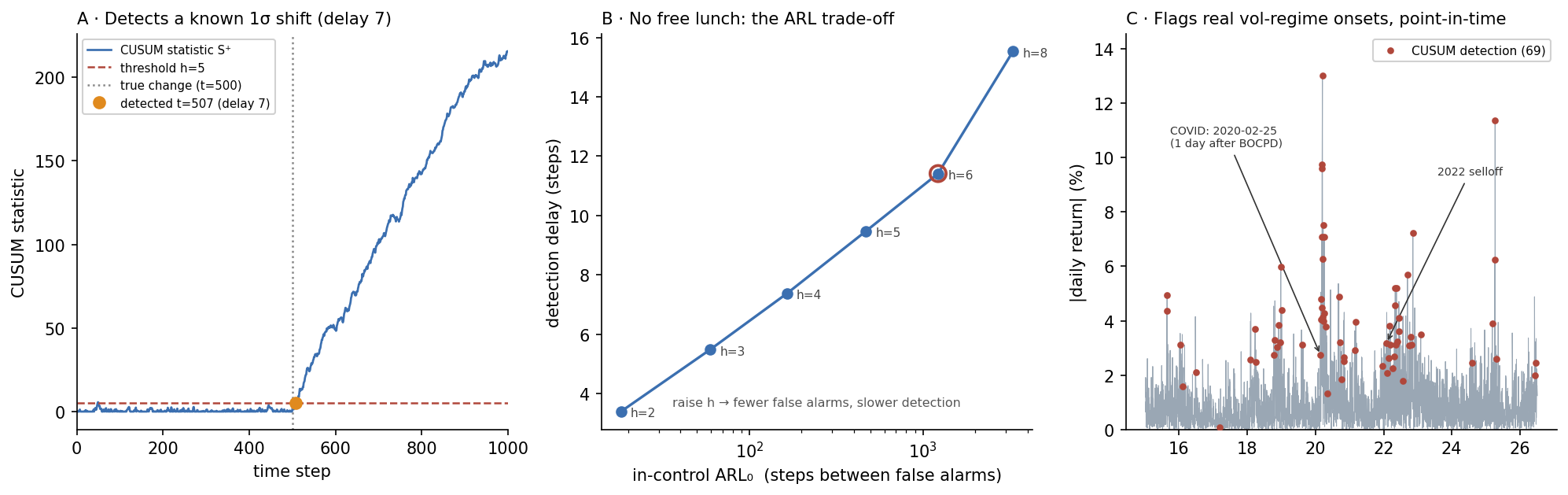
Two checks, both in the figure. First, it detects a known change: on a synthetic stream that shifts by 1\sigma at t=500, the CUSUM statistic stays at zero, then climbs after the change and crosses h=5 at t=507 — a detection delay of 7 (left panel). Second, and more important, the average-run-length (ARL) trade-off. There is exactly one free parameter, h, and it trades the two things you care about against each other:
| threshold h | in-control ARL₀ (steps between false alarms) | detection delay (1σ shift) |
|---|---|---|
| 2 | 18 | 3.4 |
| 3 | 59 | 5.5 |
| 4 | 164 | 7.4 |
| 5 | 467 | 9.5 |
| 6 | 1,223 | 11.4 |
| 8 | 3,300 | 15.5 |
This is the lesson of change detection, and it is not a shortcoming of CUSUM specifically — it is fundamental. A lower threshold catches the change faster but cries wolf constantly (ARL₀ of 18 means a false alarm every 18 steps in pure noise); a higher one is calm but slow. Every detector, Bayesian or frequentist, lives on this curve; the only question is where you choose to sit. The middle panel plots it directly — detection delay against the false-alarm interval — and the right operating point depends entirely on what a false alarm costs you versus what a slow detection does.
4. On real data — the cheap tripwire, matching BOCPD
Pointed at the Nasdaq, CUSUM earns its place. Taking the standardized absolute return as the stream, with the in-control mean and scale fixed on 2015 (no look-ahead) and h=6, it fires 69 times over eleven years — each a genuine volatility-regime onset: the August 2015 sell-off, February 2018’s volmageddon, the fourth quarter of 2018, and, cleanly, the COVID crash on 2020-02-25 — one day after BOCPD’s 2020-02-24 — and the 2022 sell-off from 28 January. It finds the same major structural breaks the Bayesian detector does, point-in-time, but at a tiny fraction of the compute: two max operations per observation versus a run-length posterior. That is precisely the division of labour the specialist wants — CUSUM running always-on as the low-latency alarm that can trigger a cheap immediate response (de-risk, widen intervals, flag for review), with BOCPD’s richer posterior consulted when the considered picture is needed.
5. What are its strengths?
- Cheap and online. One pass, O(1) memory, two additions per point — you can run it on every stream in the system at once, which BOCPD cannot afford.
- Provably efficient. For a shift of a known size and a tolerated false-alarm rate, CUSUM achieves the minimum possible detection delay (Lorden/Moustakides optimality) — it is not a heuristic.
- One interpretable knob with explicit control. The threshold h maps directly to an average-run-length, so you set the false-alarm rate in units you can reason about, and k targets the shift size.
- Model-agnostic. It monitors any stream — a return, a volatility, a correlation, or a model’s error rate, which turns it straight into a concept-drift detector.
- A clean complement to BOCPD. Frequentist tripwire beside a Bayesian posterior — the two disagree rarely and reinforce each other, which is exactly what a robust specialist wants.
6. What are its weaknesses?
- The ARL trade-off is inescapable. You cannot have fast detection and rare false alarms; every threshold is a compromise, and choosing it needs a real cost model, not a default.
- It needs a trustworthy in-control reference. A wrong baseline \mu_0,\sigma_0 mis-calibrates everything, and markets’ “normal” itself drifts, so the reference must be maintained.
- It says that, not what. CUSUM signals a change occurred; it does not give the new regime’s parameters or a probability over where the break was — BOCPD’s posterior is richer for that.
- Tuned to a shift size. k optimises for one magnitude of change; much smaller or larger shifts are detected sub-optimally, and a two-sided setup still assumes a mean-shift form.
- Detection lags by construction. The delay is the price of certainty — at the very moment the regime turns, the statistic has not yet accumulated enough evidence, so like every real-time detector it is always a little late.
7. How could it apply to markets?
CUSUM plays two roles in the proposal. As part of the structural-change specialist, it is the always-on tripwire that complements BOCPD: run continuously and cheaply on volatility, spreads, correlations and breadth, it emits a low-latency “something just changed” that can trigger an immediate, conservative response before the more expensive posterior is even computed — and because change detection concentrates value at transitions, a fast, cheap transition alarm is worth a great deal. Its second role is quieter but just as important: pointed at the system’s own agents’ error streams, CUSUM (or Page-Hinkley, or their ML descendants DDM and ADWIN) is how the Review & Learning layer detects concept drift — the moment a specialist that was reliable stops being reliable, so its reliability weight should fall and it may need refitting. And the ARL trade-off is a governance lesson the whole architecture must internalise: an alarm system’s threshold is a risk decision, not a technical default — a system near capital should set it deliberately, knowing exactly the false-alarm rate and detection delay it is buying.
8. What does the Python code look like?
import numpy as np

def cusum(x, mu0, sigma0, k=0.5, h=6.0):
    """Two-sided CUSUM on a standardized stream. Returns alarm indices (resets on alarm)."""
    z = (x - mu0) / sigma0                       # standardize against an in-control reference
    sp = sm = 0.0
    alarms = []
    for t, zt in enumerate(z):
        sp = max(0.0, sp + (zt - k))             # accumulate upward deviations beyond the slack k
        sm = max(0.0, sm - (zt + k))             # ... and downward
        if max(sp, sm) > h:                      # threshold h sets the false-alarm rate (via ARL)
            alarms.append(t); sp = sm = 0.0      # trip and reset to keep detecting online
    return alarms

# concept drift is the same detector pointed at a model's error stream:
#   cusum(rolling_error, mu0=baseline_error, sigma0=baseline_sd)  ->  "retrain me"
The detector is the two max lines; everything that matters — the false-alarm rate, the detection speed — is set by the single threshold h, chosen on the ARL curve.
9. How would I explain it to a supervisor?
“CUSUM is the cheap, online complement to the Bayesian change-point detector. It accumulates how far a stream has drifted from its in-control mean and trips when that sum crosses a threshold — two operations per data point, versus a full run-length posterior. I checked it recovers a known 1σ shift, which it caught in seven steps, and then I mapped its operating characteristic, which is the real lesson: the threshold is one knob that trades false alarms against detection speed — raising it takes the in-control false-alarm interval from 18 steps to 3,300 but slows detection from 3 to 16 steps. There’s no free lunch, and every change detector lives on that curve. On the Nasdaq, run point-in-time on absolute returns, it flagged 69 volatility-regime onsets over eleven years, including the COVID crash one day after the Bayesian detector, at a fraction of the cost. For my proposal it’s the always-on tripwire in the structural-change specialist — a fast, cheap alarm that fires a conservative response before the expensive posterior is computed — and the same detector on my own agents’ error rates is concept-drift detection, how the system knows a specialist has gone stale and needs down-weighting or refitting. And the trade-off is a governance point: the alarm threshold is a risk decision, so it should be set deliberately, knowing the exact false-alarm rate and delay it buys.”
Two-sided standardized CUSUM (slack k=0.5, optimal for a 1\sigma shift). Synthetic: N(0,1) for 500 steps then N(1,1); with h=5 the one-sided statistic crosses at t=507 (delay 7). ARL operating characteristic by Monte Carlo (3,000 runs each): h = 2/3/4/5/6/8 gives in-control ARL₀ ≈ 18/59/164/467/1,223/3,300 and mean detection delay for a 1\sigma shift ≈ 3.4/5.5/7.4/9.5/11.4/15.5. Real: Nasdaq daily 2015–2026, stream = standardized |r_t| with in-control \mu_{|r|}=0.0082, \sigma=0.0077 fixed on 2015; k=0.5, h=6 → 69 detections, including COVID 2020-02-25 (one day after the BOCPD run’s 2020-02-24) and the 2022 sell-off from 2022-01-28. Every number was checked.