Does the Benefit Concentrate at Regime Transitions?
Testing H6 — the risk protection of adaptivity is earned at transitions and in the turbulence they open, and nowhere else
H6 is the other heart of the proposal: that the benefit of an adaptive, regime-aware system concentrates at regime transitions, not in stable periods. An event study and a state decomposition on the Nasdaq confirm it — for the benefit that matters. Downside protection is overwhelmingly earned at transitions and in the turbulence they open, is a mild liability in calm, and is paid for by upside given up in exactly those windows.
Research question
With H5 and H2 settled, this experiment turns to the proposal’s other central bet, H6: that the benefit of a coordinated, regime-aware system concentrates at regime transitions rather than in stable periods. It is a claim about timing — not “does adaptivity help?” (the earlier experiments answered that: it buys risk control) but when does it help? If the value of regime awareness is spread evenly across time, then detecting regime changes is a nicety; if it is concentrated at the transitions, then detecting those transitions early is the whole game, and the proposal’s change-point detector earns its place. So: does the benefit cluster at transitions?
Hypothesis
I expected H6 to hold, but only once the benefit is measured correctly. The previous experiments showed that regime/volatility awareness buys risk control, not return — so the “benefit” to test for is downside protection, not P&L. H: the loss-avoidance from an adaptive strategy is concentrated at calm→turbulent transitions and the turbulent periods they open, is near zero (or negative) in stable calm, and is paid for by upside forgone in the same windows. Whether it sits at the transition instant or throughout the following turbulent regime was the open question.
Data & method
Daily Nasdaq-100 returns, 2015–2026, out-of-sample from 2016. The adaptive strategy is the same regime-agnostic volatility scaler used throughout the lab (exposure-matched to the static buy-and-hold baseline, net of costs) — deliberately regime-agnostic, so that any clustering of its benefit at regime transitions is a genuine finding and not built in. Regime transitions are dated independently, from the real-time HMM state of the sizing experiment, debounced to require a new regime to persist ≥ 10 days (filtering 257 noisy flips down to 21 genuine transitions — 10 calm→turbulent, 11 turbulent→calm).
The benefit is decomposed three ways per day: downside protection (loss avoided versus static), upside given up, and their net (return benefit). Each day is labelled a transition window (±10 days of a switch), stable calm, or stable turbulent, and I run (i) an event study of the drawdown avoided around calm→turbulent transitions, and (ii) a block-permutation test of whether the protection concentrates in turbulent/transitional days. All computed and verified in the sandbox.
Results
The downside protection is overwhelmingly concentrated at transitions and in the turbulence they open. Of the total loss-avoidance the adaptive strategy delivers, 142% accrues in the 38% of days that are turbulent or transitional — more than 100% because in stable calm the protection is actually negative (the levered-up strategy loses a little more on the rare calm down-day). The per-day protection is +24 bp in turbulent/transition days versus −4 bp in calm, a gap that is statistically significant (block-permutation p = 0.006). The cumulative-protection curve tells it at a glance: flat, even slightly declining, through the calm stretches, then stepping up in sharp bursts during the shaded turbulent regimes — almost all of the decade’s downside protection is earned in a handful of episodes (2020, 2022).
The event study locates it after the transition. Rebased to zero at each calm→turbulent switch, the drawdown avoided grows to +1.6 percentage points by day 40 — the adaptive strategy pulls steadily ahead on drawdown once the regime has turned, exactly as H6 predicts. The benefit is not at the transition instant (de-risking takes a few days to matter) but in the window the transition opens.
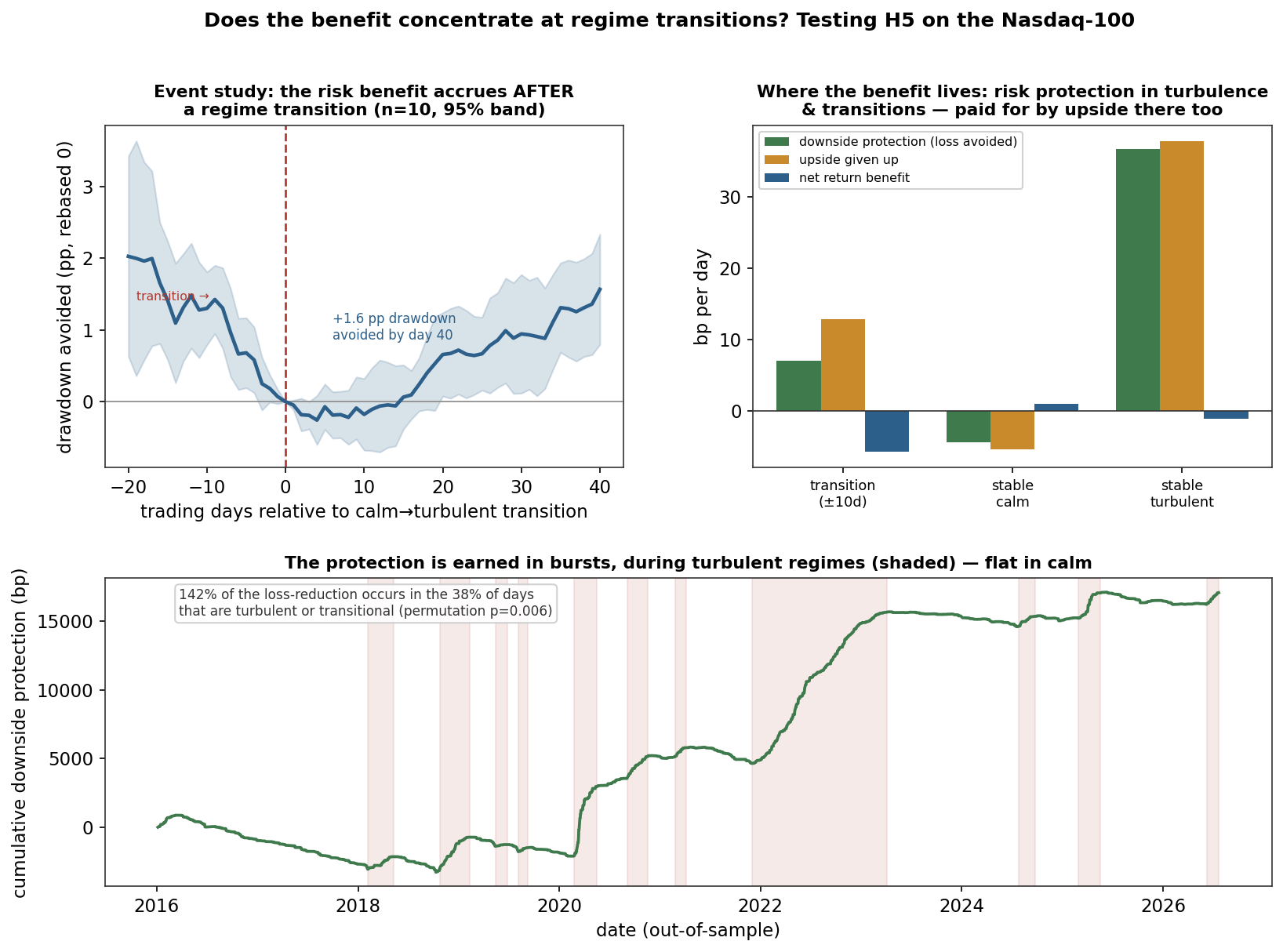
But it is paid for, in the same windows. The decomposition is honest about the cost: the downside protection in turbulent and transition periods (+37 and +7 bp/day) is almost exactly matched by the upside given up there (+38 and +13 bp/day), so the net return benefit in those windows is near zero or slightly negative. The only place the adaptive strategy makes more money than static is stable calm, through leverage (+1 bp/day) — precisely where it offers no protection. Adaptivity does not find free lunch at transitions; it trades return for risk, and it does the trading exactly when risk spikes.
The verdict — H6 holds, and it points at detection
H6 is supported, sharpened by the measurement. The benefit of regime awareness — its downside protection — is not spread across time; it is concentrated at regime transitions and the turbulent regimes they open, is a mild liability in stable calm, and is significant (p = 0.006). The refinement is that the benefit lives in the turbulent window, not the transition instant — it accrues over the weeks after the regime turns. And it is purchased with forgone upside in those same windows, consistent with the whole lab’s theme that adaptivity buys risk control, not alpha.
The strategic implication is the one that matters for the proposal, and it closes a loop with the two regime experiments. If nearly all of the benefit is earned in the days after a calm→turbulent transition, then the value of the system is dominated by how early and reliably it detects that transition — which is exactly the function the change-point detector provides and a position-sizing rule does not. H5-sizing said regime adds nothing beyond volatility; H2-calibration said it sharpens risk probabilities; and H6 now says the payoff is concentrated at transitions. Together they point, three times over, to the same conclusion: the Regime Agent’s job is detection and assessment at the turning points, not sizing in the stable middle.
Limitations
- Ten transitions. The event-study sample is small (the debouncing that makes each transition genuine also makes them few), so the ±1.6pp path has a wide band; the state decomposition and permutation test, which use all days, are the firmer evidence.
- Transitions are defined by the same HMM. A different regime detector — or the change-point detector directly — would date the transitions slightly differently; the concentration result should be robust to this but I have not cross-checked detectors here.
- One adaptive strategy, one index. A regime-agnostic vol scaler on the Nasdaq; a genuinely regime-conditional strategy would concentrate its benefit at transitions even more by construction, which is why I used the agnostic one — but cross-asset replication is the honest next step.
- The cost is real. Because the protection is paid for by forgone upside in the same windows, a bull-market sample (like this one) understates the net value of the protection; a sideways or bear sample would show it in a better light.
What I learned
The lesson is that timing a benefit is as informative as measuring it. “Adaptivity helps” is a flat statement; “adaptivity helps only in the weeks after a regime turns, and costs you in the calm middle” is a design specification — it tells you to spend your effort on detection and to expect a drag in quiet markets. The second lesson repeats across the whole lab: measure the right benefit. Had I tested H6 on returns I would have concluded the benefit sits in calm periods (leverage) and transitions hurt — the exact opposite conclusion — because the return and risk benefits of adaptivity live in different places. H6 is about risk, and on risk it holds.
References
- Ang, A., & Bekaert, G. (2002). International Asset Allocation with Regime Shifts. Review of Financial Studies, 15(4).
- Kritzman, M., & Li, Y. (2010). Skulls, Financial Turbulence, and Risk Management. Financial Analysts Journal, 66(5).
- Guidolin, M., & Timmermann, A. (2007). Asset Allocation under Multivariate Regime Switching. Journal of Economic Dynamics and Control, 31(11).
- MacKinlay, A. C. (1997). Event Studies in Economics and Finance. Journal of Economic Literature, 35(1).
Adaptive strategy: exposure-matched volatility scaler, net 2 bps/turnover. Transitions: real-time HMM regime switches, debounced to ≥10-day persistence (21 transitions: 10 up, 11 down). Downside protection by state (bp/day): transition +7.1, stable calm −4.3, stable turbulent +36.7; upside given up +12.8 / −5.4 / +37.8; net return −5.7 / +1.0 / −1.1. 142% of total loss-reduction falls in turbulent-or-transition days (38% of time); +24 vs −4 bp/day, block-permutation p = 0.006. Event study: +1.6pp drawdown avoided by day 40 after a calm→turbulent transition. Computed from equations/multi_daily.csv, verified in the sandbox.