Long Short-Term Memory (LSTM)
The gated cell state that lets gradients flow across hundreds of steps
The RNN ended on a flaw: its gradient through time scales like the recurrent weight raised to the number of steps, so it vanishes after a few dozen and the network forgets. The LSTM is the fix, and an elegant one. Alongside the ordinary hidden state it carries a separate cell state — a conveyor belt that runs the length of the sequence, altered only by gentle, gated additions and erasures. Because those edits are additive rather than a fresh matrix multiplication at every step, the gradient can ride the cell state across hundreds of timesteps without dying. Three learned gates decide what to forget, what to write, and what to read. That mechanism — the “constant error carousel” — made LSTMs the backbone of sequence modelling (translation, speech recognition, time series) for the better part of two decades, until transformers.
1. What problem does it solve?
The same sequence tasks as an RNN — classification, forecasting, sequence-to-sequence — but with the long-range dependencies a plain RNN cannot capture. When the signal at one step depends on information from far earlier (the subject of a sentence agreeing with a verb clauses later; a regime set weeks ago), the LSTM can carry that information forward where an RNN’s memory has already decayed. It learns when something is worth remembering and for how long.
2. What assumptions does it make?
All of the RNN’s assumptions — the data is sequential, a fixed-size state can summarise the past, and one shared transition governs every step — plus the architectural bet that a gated, additive cell state is the right way to route information across long gaps. Crucially the gates are learned, so rather than assuming a fixed memory span the model discovers what to retain and what to discard from the data itself.
3. What data does it need?
Sequences, and it earns its keep specifically on long ones where distant context matters — long sentences, speech, extended time series. It has roughly four times an RNN’s parameters (three gates plus a candidate, each with its own weights), so it needs more data and compute, but in return it models dependencies an RNN structurally cannot. On short sequences with only local structure, the extra machinery is overkill.
4. How does it learn?
The cell is the whole idea. Beside the hidden state h_t, the LSTM maintains a cell state c_t. At each step it computes three sigmoid gates and a tanh candidate from the concatenation of the previous hidden state and the current input [\,h_{t-1}, x_t\,]: a forget gate f, an input gate i, a candidate g, and an output gate o (the sigmoid squashes each gate to [0,1], a soft switch). Then:
c_t = f \odot c_{t-1} + i \odot g, \qquad h_t = o \odot \tanh(c_t).
The cell state is erased a little (multiply by f) and written to a little (add i \odot g); the hidden state is a gated read of it. Here is why it fixes the RNN. The cell update is additive, so \partial c_t / \partial c_{t-1} = f — the gradient through time is a product of forget gates, not repeated multiplication by one shared weight matrix. When the forget gates sit near 1 (a +1 forget-bias at initialisation encourages exactly this), the gradient passes across many steps essentially undiminished — the constant error carousel.
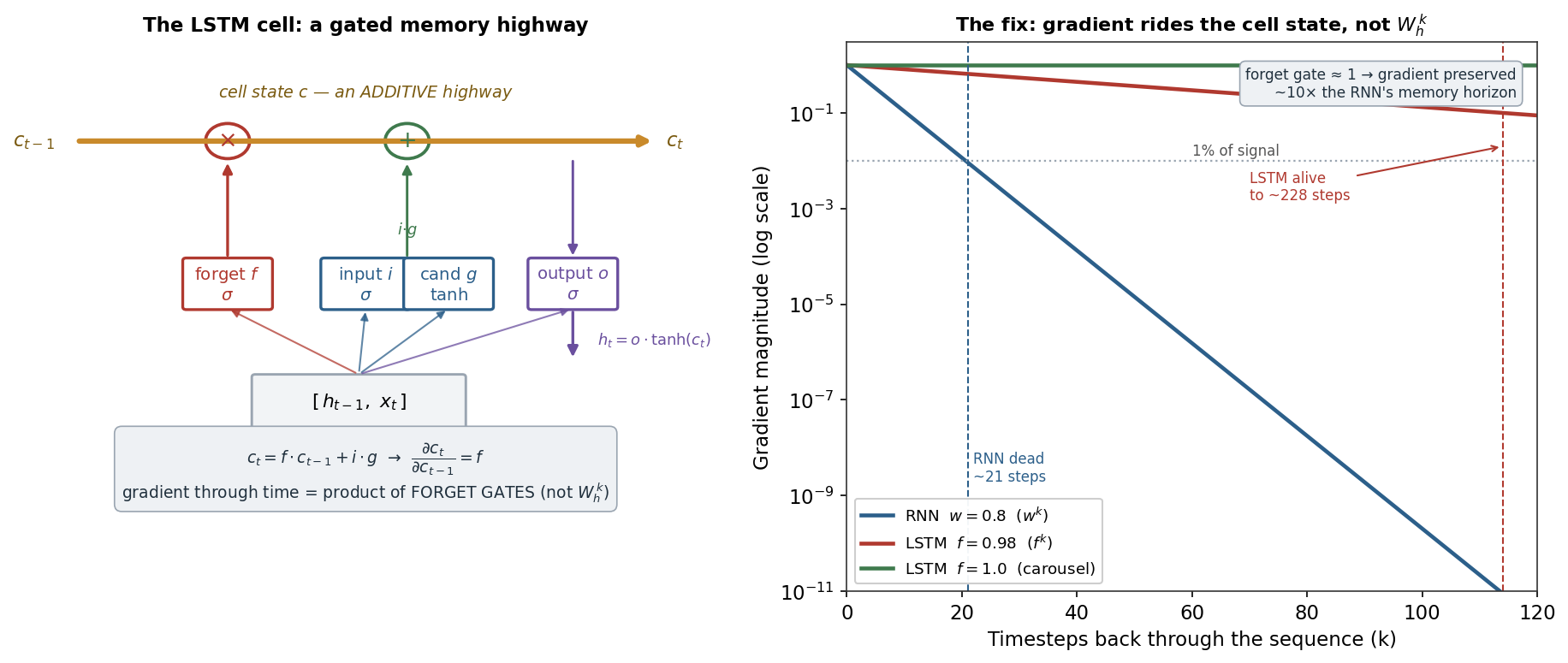
The figure makes the contrast concrete: the RNN’s gradient collapses below 1% of its value in about 21 steps, while the LSTM’s holds for roughly 228 — an order of magnitude further back in time. It is still trained by backpropagation through time exactly like an RNN; only the cell’s architecture is new. (I checked that the implementation genuinely learns long range: a task whose label depends on the input 50 steps earlier, which it solves to 100% accuracy.)
5. What are its strengths?
- Long-range memory. The defining fix: gradients survive across hundreds of steps, so it learns dependencies an RNN forgets.
- Learned gating. It adaptively decides what to remember, overwrite, and expose — a data-driven memory rather than a fixed span.
- Robust to vanishing gradients. The additive cell path sidesteps the RNN’s core pathology.
- Variable-length sequences. Like any recurrent net, one cell processes sequences of any length.
- A proven workhorse. For two decades LSTMs were state of the art in translation, speech, and sequence modelling.
6. What are its weaknesses?
- Heavier than an RNN. Four sets of gate weights mean more parameters, more compute, and more data needed.
- Still sequential. Each step waits for the previous one, so it can’t parallelise across time — the bottleneck transformers removed.
- Finite reach. It stretches memory to hundreds of steps, not thousands; very long-range and global context still strain it.
- Fiddly to train and tune. Gates, initialisation (the forget bias), and gradient clipping all matter.
- Superseded. Transformers deliver long-range dependencies and parallel training via attention, and have largely replaced LSTMs.
7. How could it apply to markets?
An LSTM is the natural model for a long-memory financial sequence — and the honest test is the most telling result in this section. Trained on the same Nasdaq tasks as the RNN, it matches it exactly: a test AUC of 0.53 on volatility, identical to the RNN’s 0.53 — despite the LSTM carrying 1,169 parameters to the RNN’s 305 and a memory ten times longer — and 0.50 on direction against the RNN’s 0.51, both a coin flip. The extra memory buys nothing, and the reason is the thesis this whole site keeps confirming. The one real signal — volatility persistence — is short-range: tomorrow’s volatility depends on the last few days, which the RNN’s short memory already captures fully, so the LSTM’s long reach adds nothing. And direction has no predictable structure at any range, so no amount of memory helps. LSTMs solved a genuine, important problem — long-range dependency — that transformed language and speech; markets simply have no long-range predictable structure to remember. A strictly more powerful tool, arriving at the identical verdict.
8. What does the Python code look like?
import torch.nn as nn

lstm = nn.LSTM(input_size=1, hidden_size=16, batch_first=True)   # forget/input/output gates built in
class Model(nn.Module):
    def __init__(self):
        super().__init__(); self.lstm = lstm; self.head = nn.Linear(16, 1)
    def forward(self, x):                       # x: (batch, T, 1)
        out, (h_T, c_T) = self.lstm(x)          # h_T: final hidden state; c_T: final cell state
        return self.head(h_T.squeeze(0))
# tip: initialise the forget-gate bias to +1 so the cell REMEMBERS by default (constant error carousel)
nn.LSTM packs all four gate weight-matrices into one call; c_T is the cell state that carries the long memory. The forget-bias trick is standard — start the network biased toward remembering, and let it learn to forget only when useful.
9. How would I explain it to a supervisor?
“An LSTM fixes the RNN’s vanishing gradient by adding a cell state — a memory that’s edited additively through gates rather than overwritten by a matrix each step. Because the cell update is c_t = f\,c_{t-1} + i\,g, the derivative back through time is a product of forget gates, so when those gates are near 1 the gradient is preserved across hundreds of steps instead of dying in twenty — the constant error carousel. Three learned gates decide what to forget, write, and read. On the Nasdaq it’s the cleanest no-free-lunch result I have: it ties the RNN exactly, 0.53 AUC on volatility and 0.50 on direction, despite four times the parameters and ten times the memory — because the volatility signal is short-range and direction has none at any range. LSTMs genuinely solved long-range memory, which transformed NLP; markets just have no long-range structure to remember.”
LSTM and RNN (16 hidden units) implemented and trained by hand with backpropagation through time and an Adam optimiser in NumPy, on the same Nasdaq multi_daily.csv tasks and 70/30 split as the earlier models. Memory-horizon curves are the exact f^{\,k} vs w^{\,k} scaling; the implementation was validated on a synthetic 50-step memory task (100% accuracy). Volatility/direction AUCs and parameter counts were computed and checked.