Multi-Agent Systems & Credit Assignment
When several agents share one P&L — Markov games, and the fair attribution of a joint outcome
Every entry in this tier so far concerned a single decision-maker. But the proposal’s architecture is not one agent — it is a team: a Regime Agent, a News Agent, an RL Trading Agent, a Risk Agent, all feeding one decision that produces one profit or loss. That raises a question none of the single-agent methods can answer: when the desk makes money, which agent earned it? — and when it loses, which one is to blame? This is the credit assignment problem, and it is precisely the job the proposal gives its fifth agent, the Review & Learning Agent (“attributes outcomes… agent contribution”). This entry supplies that agent’s formal foundations: Markov games as the framework for many agents acting together, and the Shapley value as the unique fair way to split a shared outcome among them. Applied to a real four-agent Nasdaq strategy, the method does what a good attribution should — it overturns the naïve story, and it does so with a ground-truth guarantee (the efficiency axiom) verified to machine precision.
1. What problem does it solve?
Two coupled problems that appear the moment more than one agent acts. First, how to model several agents whose actions jointly drive a shared environment — each one’s best move depends on what the others do, and from any single agent’s viewpoint the world is no longer stationary. Second, and the focus here, how to assign credit: a team that shares a single reward gives no agent a clean signal of its own contribution, so learning stalls and, worse, evaluation lies — a redundant agent can look useless, and a genuinely harmful one can hide behind its teammates. Getting attribution right is what lets a multi-agent system both learn (each agent needs its own gradient) and be governed (a human needs to know which component to fix).
2. Markov games — the framework
A Markov game (stochastic game) is the multi-agent generalisation of the MDP: a shared state s, one action set A_i per agent, a transition P(s' \mid s, a_1,\dots,a_n) driven by the joint action, and a reward R_i for each agent. With one agent it collapses to an MDP; with two zero-sum agents it is the setting of minimax and game theory; the proposal’s case is cooperative — the agents share a team objective (risk-adjusted P&L). The defining difficulty is that each agent’s environment includes the others, who are also adapting, so the stationarity that let Q-learning and PPO converge is broken: a policy that was optimal yesterday may not be today because a teammate changed. That non-stationarity is a core reason the proposal keeps most agents’ functions bounded and auditable — and several of them deterministic — rather than turning a swarm of free-running learners loose on each other.
3. Credit assignment — from difference rewards to Shapley
Give a cooperative team a single reward and each agent faces the structural credit assignment problem (distinct from the temporal one TD learning solves): of the shared outcome, how much was me? The cheap answer is a difference reward — team performance minus what it would have been with agent i replaced by a default action, D_i = G(a) - G(a_{-i}, c_i) — which isolates i’s marginal effect in one counterfactual and, as COMA, gives a low-variance policy-gradient baseline (the same variance-reduction logic as a value baseline, now counterfactual). But one counterfactual depends on when you remove the agent. The principled answer averages over all of them: the Shapley value,
\phi_i \;=\; \sum_{S \subseteq N\setminus\{i\}} \frac{|S|!\,(n-|S|-1)!}{n!}\,\big(v(S \cup \{i\}) - v(S)\big),
the mean marginal contribution of agent i across every coalition S it could join. It is the unique attribution satisfying four fairness axioms — efficiency (\sum_i \phi_i = v(N) - v(\varnothing), the parts sum to the whole), symmetry (equal contributors get equal credit), null player (an agent that never changes the outcome gets zero), and linearity. It is exactly the machinery of SHAP from earlier in this library — there the “players” were features in a prediction; here they are agents in a P&L. The one cost is that Shapley sums over 2^n coalitions, so for many agents it is approximated by Monte-Carlo sampling or by difference rewards — which are simply a single term of this sum.
4. What did the demonstration show?
Ground truth first. I verified the Shapley implementation on a hand-computable game (additive values with one pairwise interaction): it returned exactly the derived [5, 7, 7], the efficiency axiom held to \Delta = 0, and a constructed null player received exactly zero while symmetric players tied. The attributor is provably correct before it is trusted.
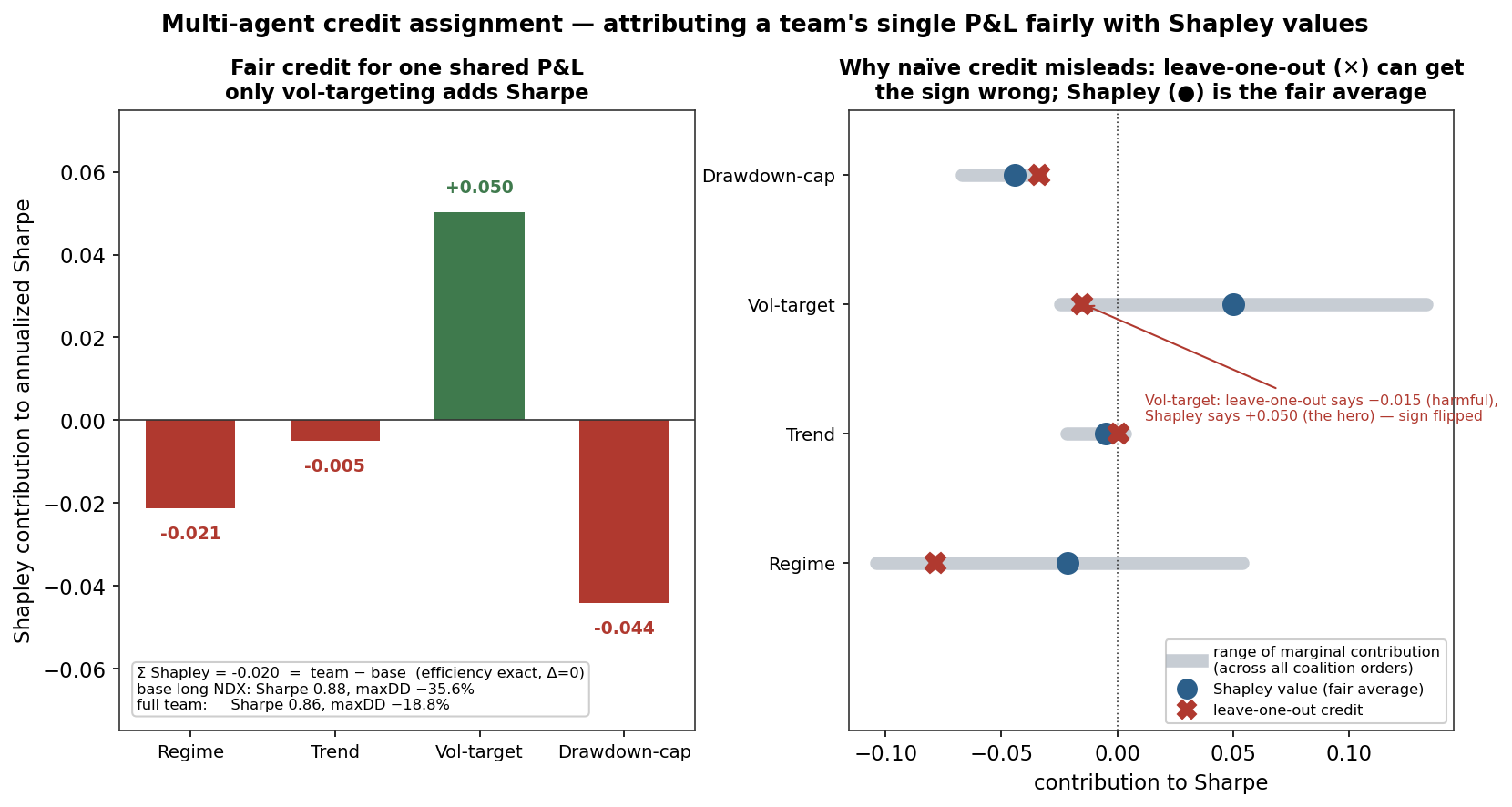
Then the team. I built a four-agent Nasdaq strategy on a long base — a Regime agent (de-risk when turbulent), a Trend agent (cut in downtrends), a Vol-target agent (scale to a volatility target), and a Drawdown-cap agent (cut in deep drawdowns) — and used each coalition’s annualised Sharpe as the value function, so the Shapley values attribute the team’s risk-adjusted performance (left panel). The result is bracingly honest and not what a promoter would claim: over a decade-long Nasdaq bull market, only the Vol-target agent adds Sharpe (+0.050); Regime (-0.021), Trend (-0.005) and Drawdown-cap (-0.044) each subtract it, because de-risking into a market that kept recovering cost return. The full team’s Sharpe is a touch lower than buy-and-hold (0.855 vs 0.875) — but its maximum drawdown is nearly halved (-18.8\% vs -35.6\%). The Shapley values sum to the total change to twelve decimals: attribution that balances exactly.
Two findings make the case for doing this properly. Leave-one-out credit gets the sign wrong (right panel). Drop the Vol-target agent from the full team and performance barely moves (-0.015) — because the other risk agents compensate — so a naïve “who was on when we profited” audit would call it harmful. Averaged fairly across all coalitions, Shapley reveals it as the single most valuable agent (+0.050): the redundancy that hides its value from leave-one-out is exactly what the Shapley average sees through. And credit depends on the objective: re-run the attribution on maximum drawdown instead of Sharpe and the Regime agent flips from worst-on-Sharpe (-0.021) to the largest contributor (+0.100, cutting drawdown), while the Drawdown-cap agent — supposedly the specialist — contributes essentially nothing to drawdown (-0.001), the regime and vol agents having already done the work. Whom you reward depends entirely on what you are optimising.
5. What are its strengths?
- A single principled framework for the whole architecture. Markov games describe every interacting agent in the proposal at once, rather than four disconnected single-agent stories.
- Fair, axiomatic attribution. Shapley is the unique credit split satisfying efficiency, symmetry, null-player and linearity — not a heuristic, and it balances exactly (the efficiency check).
- It overturns naïve audits. As shown, leave-one-out mis-signs redundant agents; Shapley sees through the redundancy — precisely the value a Review Agent adds.
- Reuses the library’s machinery. It is SHAP with agents as players, and its difference-reward form is a counterfactual baseline for learning.
- Diagnostic, not just descriptive. The attribution tells you which agent to fix, retrain or retire — the feedback the Review & Learning Agent exists to provide.
6. What are its weaknesses?
- Exponential cost. Exact Shapley sums over 2^n coalitions; beyond a handful of agents it needs Monte-Carlo or difference-reward approximation, with the attendant sampling error.
- It depends on the counterfactual. “Agent off” needs a defined default; a different baseline action changes the attribution, so the choice must be justified, not assumed.
- Objective-dependent. Sharpe and drawdown gave different — even opposite — credit; the attribution is only as meaningful as the value function chosen, which is a modelling decision.
- Markov-game non-stationarity. Convergence and equilibrium selection are genuinely hard when agents co-adapt; multi-agent learning has far weaker guarantees than the single-agent case.
- Backtest fragility. The value function here is one historical path, gross of costs; the attribution inherits every limit of a single-sample, cost-free evaluation.
7. How could it apply to markets?
This is the proposal’s Review & Learning Agent, formalised. That agent’s remit — “attributes outcomes… agent contribution” — is exactly a Shapley computation over the desk’s agents: given a period’s P&L, how much did the Regime, News, Trading and Risk agents each contribute, fairly and additively? The demonstration is the argument for why it must be principled rather than naïve. A back-of-envelope audit that credits whichever agent was active during good months would have branded the strategy’s single most valuable component harmful, because redundant risk agents mask each other — and it would have mis-ranked them entirely under the wrong objective. A desk that reallocates capital or retrains models on such attributions optimises the wrong thing. The honest, uncomfortable findings are the feature, not a bug: a reactive drawdown stop can destroy Sharpe and fail to cut drawdown; de-risking overlays cost return in a bull market while earning their keep in tail protection; value is inseparable from the objective. Surfacing exactly these truths, with an attribution that provably balances, is the review loop that the AI Trading Systems design insists separates a research system from automated overconfidence. And the framework’s non-stationarity is itself an argument for the proposal’s restraint — bounded, auditable, largely deterministic agents rather than a swarm of co-adapting learners whose interactions no one can attribute.
8. What does the Python code look like?
from itertools import combinations
from math import factorial
import numpy as np

def shapley(v, n):
    """Exact Shapley values of a characteristic function v(frozenset)->float.
       Verify with the efficiency axiom: sum(phi) == v(all) - v(none)."""
    phi = np.zeros(n)
    for i in range(n):
        others = [j for j in range(n) if j != i]
        for k in range(len(others) + 1):
            for S in combinations(others, k):
                weight = factorial(k) * factorial(n - k - 1) / factorial(n)
                phi[i] += weight * (v(frozenset(S) | {i}) - v(frozenset(S)))   # marginal contribution
    return phi

# v(S) = performance (e.g. annualised Sharpe) of the strategy using ONLY the agents in coalition S
phi = shapley(v_sharpe, n_agents)
assert abs(phi.sum() - (v_sharpe(frozenset(range(n_agents))) - v_sharpe(frozenset()))) < 1e-9  # efficiency
# a difference reward is one term of this sum: D_i = v(N) - v(N \ {i})  (leave-one-out) — cheaper, and, as shown, can mislead
The whole method is the marginal contribution v(S\cup\{i\}) - v(S), weighted so that every ordering of the agents counts equally. The assert is the ground truth: a correct Shapley computation must have its parts sum to the whole.
9. How would I explain it to a supervisor?
“My proposal is a team of agents that together make one decision and earn one P&L, so I need to say which agent deserves the credit — that’s the Review Agent’s job, and multi-agent RL gives it two tools. Markov games are the framework: a shared state, joint actions, and — because the agents co-adapt — no stationarity, which is why I keep most agents bounded and auditable. Credit assignment is the hard part: a shared reward doesn’t tell any agent what it personally contributed. The fair answer is the Shapley value, the average marginal contribution over all orderings — the unique attribution that’s efficient, symmetric, and gives null agents zero; it’s literally SHAP from earlier in my library, with agents as the players instead of features. I verified my implementation on a game with known Shapley values and the efficiency axiom held exactly, then attributed a four-agent Nasdaq strategy’s Sharpe. The result was honest and surprising: only the vol-targeting agent added risk-adjusted return, and a naïve leave-one-out audit got its sign wrong — called the most valuable agent harmful — because the risk agents are redundant and mask each other, which only the Shapley average sees through. And the credit flipped entirely under a drawdown objective, where the regime agent became the top contributor. That’s the whole point of the Review Agent: fair, objective-aware attribution that overturns the naïve story and tells you which component to actually fix.”
Framework: cooperative Markov game; attribution by exact Shapley values (sum over all 2^n coalitions). Ground-truth check: hand-computable game (additive + one pairwise interaction) recovered Shapley [5,7,7], efficiency \Delta=0, null-player =0, symmetry exact. Strategy: long-NDX base with four switchable agents — Regime (0.40× exposure when 20-day vol above its expanding median), Trend (0.50× when 100-day momentum <0), Vol-target (\text{clip}(\text{median vol}/\text{vol}_{20}, 0.3, 1.5)), Drawdown-cap (0.50× when NDX 60-day drawdown <-10\%); all signals lagged one day (no leakage), gross of costs, 2015–2026, n=2{,}903. Value = annualised Sharpe: base 0.875 (maxDD −35.6%), full team 0.855 (maxDD −18.8%); Shapley R −0.021, T −0.005, V +0.050, D −0.044, sum −0.020 = team−base (\Delta=0). Vol-target leave-one-out −0.015 vs Shapley +0.050 (sign flip). Second objective (max drawdown): Shapley R +0.100, T +0.022, V +0.046, D −0.001; base −0.356 → team −0.188 (\Delta = 3\times10^{-17}). Every number was checked.