Contextual Bandits — Conditional Reliability, Learned
Choosing which expert to trust given the regime, from partial feedback — the transparent, provably-efficient alternative to full reinforcement learning
The expert-weighting entry left a puzzle: adaptive weighting barely beat a simple average, because it combined the experts unconditionally — it never learned that a forecaster reliable in a calm market is useless in a crisis. The fix, in principle, is to condition on the regime: learn which expert to trust in which state. That is exactly what a contextual bandit does — it observes a context, picks an action, sees only the reward of what it picked, and learns a context→action policy with a regret guarantee. It is the proposal’s transparent alternative to full reinforcement learning, and the concrete mechanism for conditional expert reliability. This entry builds it, verifies it recovers conditional reliability perfectly when the structure is there — and reports honestly that, on real volatility forecasting, the structure is too weak to exploit.
1. What problem does it solve?
Learning which action is best for the current situation, from partial feedback. A full supervised model needs to know the right answer for every case; a bandit only ever sees the reward of the action it actually took, which is the realistic setting for a decision system — you find out how the trade you made did, not how the trades you didn’t make would have done. The contextual bandit adds the crucial twist: the best action depends on an observed context, so it must learn a policy, not a single best action. Point the context at the market regime and the actions at the specialists, and the bandit learns condition-specific reliability — trust the volatility model in a crisis, the trend model in a calm trend — the missing ingredient from unconditional weighting. And it does this without the machinery of full reinforcement learning: no long-horizon credit assignment, just a one-step decision with a provable regret bound, which is why the proposal treats it as the transparent, auditable option.
2. LinUCB — optimism under uncertainty
The workhorse is LinUCB. It assumes each arm’s expected reward is linear in the context, \mathbb{E}[r\mid x,a]=x^\top\theta_a, keeps a ridge-regression estimate \hat\theta_a=A_a^{-1}b_a per arm, and — the clever part — chooses the arm that maximises an upper confidence bound:
a_t = \arg\max_a\; x_t^\top\hat\theta_a \;+\; \alpha\sqrt{x_t^\top A_a^{-1}x_t},
then updates only the chosen arm, A_{a}\mathrel{+}=x_tx_t^\top, b_{a}\mathrel{+}=r_t x_t. The first term is exploitation (the estimated reward); the second is exploration — it inflates the value of arms whose reward is uncertain in this context, so the bandit tries them until it knows better. This “optimism under uncertainty” delivers a regret that grows only like O(\sqrt{T}): the average regret vanishes, so the policy converges to the best context-dependent one, with no hand-tuned exploration schedule.
3. Verifying it recovers conditional reliability
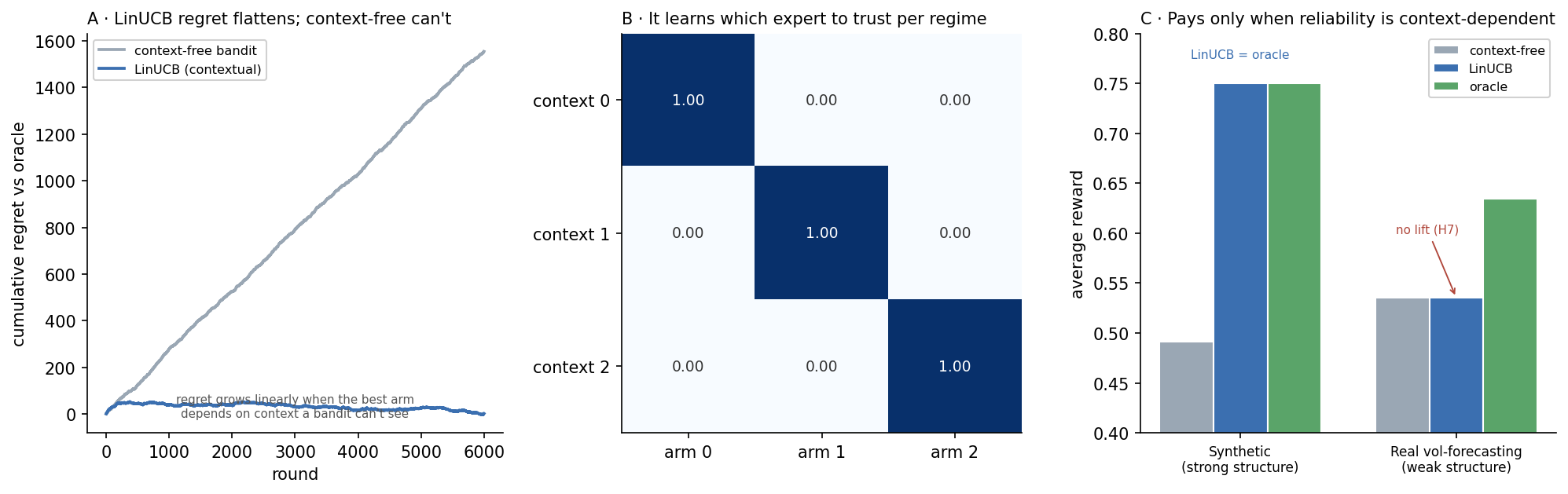
The clean test uses a task where the answer is known: three regimes, three experts, each expert reliable in a different regime (75% accurate in its own, 35% elsewhere) — the archetype of conditional reliability. The results are decisive. A context-free bandit, which cannot see the regime, is stuck at 0.49 average reward (it can only find one global-best arm, and there isn’t one); LinUCB reaches 0.750 — exactly the oracle, the best any policy could do. And its learned routing (middle panel) is a perfect identity: it sends regime 0 to expert 0, regime 1 to expert 1, regime 2 to expert 2. Its cumulative regret flattens while the context-free bandit’s grows linearly (left panel). When conditional reliability is real, the contextual bandit finds it, optimally — this is the mechanism working, verified against ground truth.
4. On real data — an honest null
Now the real test. The arms are the three volatility forecasters from the expert-weighting entry — fast EWMA, slow EWMA, and HAR — the context is the current volatility regime, and the reward is each forecaster’s accuracy; the bandit learns which forecaster to trust in which regime. The conditional structure is there: HAR is marginally best in calm and mid-volatility, the fast EWMA in high volatility. But the margins are within the noise — in the calm regime HAR scores 0.676 against the fast EWMA’s 0.670 — and the consequence is unambiguous: LinUCB (0.535) does not beat a context-free bandit (0.535) or simply always using the single best forecaster (0.539). The best-per-day oracle (0.635) is unreachable because most of that gap is luck, not learnable context. The contextual bandit paid nothing, and its exploration cost made it, if anything, marginally worse than the fixed choice.
This is the same lesson the whole combination arc keeps returning: ensembles help in proportion to diversity, adaptive expert weighting in proportion to a changing winner, and contextual bandits in proportion to exploitable context-dependence — and real markets often do not supply enough of any of them. It is a clean instance of the proposal’s H7: the transparent baseline is not beaten by the more elaborate adaptive method, because the structure it needs to exploit is too weak. That the method is provably optimal when the structure exists (§3) and still does not pay here (§4) is exactly the honest, evidence-first result the proposal is built to produce.
5. What are its strengths?
- A regret guarantee from partial feedback. LinUCB learns a context→action policy at O(\sqrt{T}) regret, seeing only the reward of the action it took — the realistic decision setting, handled with a proof.
- It is the conditional-reliability mechanism. Context = regime, arms = experts: it learns which specialist to trust in which state, and recovers that routing exactly when it exists (verified identity map).
- Transparent and auditable. A linear reward model per arm with inspectable weights is the control-first alternative to opaque deep RL — you can see why it routed as it did.
- Principled, schedule-free exploration. Optimism under uncertainty explores exactly the arms it is unsure about, with no hand-tuned \epsilon or annealing.
- One-step and sample-efficient. No long-horizon credit assignment, so it is far more stable and data-thrifty than full sequential RL — the right tool when the decision is essentially myopic.
6. What are its weaknesses?
- It only pays with exploitable context-dependence. The real null is the headline weakness: when the best action barely depends on context, or the dependence is within estimation noise, the bandit gives no lift and its exploration can cost — verify the structure, do not assume it.
- Linearity is an assumption. LinUCB models reward as linear in the context; poor or nonlinear features mislead it (kernel and neural bandits relax this, at the cost of the clean guarantee).
- Exploration has a price. Trying suboptimal arms to learn is costly in high-stakes, low-repetition settings — you may not get enough pulls to justify the exploration before the world changes.
- It is myopic. It optimises immediate reward and ignores that today’s action can change tomorrow’s state — the gap that full reinforcement learning exists to fill, at the price of stability.
- Stationarity is assumed. Reliability that drifts breaks a vanilla bandit; it needs discounting or sliding windows, the same non-stationarity caveat as everything on this site.
7. How could it apply to markets?
In the proposal contextual bandits are the transparent RL comparator for the weighting and allocation decision — the method §9.2 lists alongside deterministic rules and Bayesian updating precisely because it offers a regret guarantee and an auditable policy without full RL’s opacity and instability. Their natural job is conditional expert reliability: routing among specialists by regime, which is the honest version of the “condition-specific reliability histories” the architecture needs so the consensus engine can weight each specialist by what it is worth now. The demonstration sets the design rule directly. The mechanism is correct and provably optimal when reliability is context-dependent — so it belongs in the toolkit — but the real-data null says it must earn its place on evidence: only deploy context-conditional routing where the conditional structure is shown to be strong enough to beat a fixed best expert, exactly as the regime-conditioning experiment found that a discrete regime added nothing over volatility for sizing. Contextual bandits are how a control-first system does adaptive selection with a guarantee and an audit trail; the discipline is to use them where they pay and to say so honestly when they do not.
8. What does the Python code look like?
import numpy as np

def linucb(contexts, reward, K, alpha=1.0):
    """contexts: T x d. reward(t, a): bandit feedback for the chosen arm only."""
    T, d = contexts.shape
    A = [np.eye(d) for _ in range(K)]          # per-arm covariance (ridge)
    b = [np.zeros(d) for _ in range(K)]
    chosen = np.zeros(T, int)
    for t in range(T):
        x = contexts[t]
        ucb = np.empty(K)
        for a in range(K):
            Ainv = np.linalg.inv(A[a]); theta = Ainv @ b[a]
            ucb[a] = x @ theta + alpha * np.sqrt(x @ Ainv @ x)   # exploit + optimism
        a = int(np.argmax(ucb)); r = reward(t, a)                # see only the chosen arm's reward
        A[a] += np.outer(x, x); b[a] += r * x                    # update just that arm
        chosen[t] = a
    return chosen
With contexts = onehot(regime) and the arms as experts, the learned policy is a table of which specialist to trust in which regime — conditional reliability, learned online with a guarantee.
9. How would I explain it to a supervisor?
“Contextual bandits are the transparent alternative to full RL, and they’re how I’d learn condition-specific expert reliability — trust the volatility model in a crisis, the trend model in a calm market. LinUCB keeps a linear reward estimate per arm and picks the arm with the highest upper confidence bound, so it explores exactly what it’s unsure about, with square-root-T regret. I verified it on a task where each of three experts is best in a different regime: a context-free bandit is stuck at 0.49 average reward, but LinUCB reaches 0.75 — exactly the oracle — and its learned routing is a perfect identity, each regime to its expert. So the mechanism works. Then I ran it for real, routing among three volatility forecasters by volatility regime, and it was an honest null — LinUCB scored 0.535 versus 0.539 for just using the single best forecaster, because the conditional structure, while real, is within the noise. That’s the same lesson as my ensemble and expert-weighting work and it’s my H7: adaptive methods only beat simple baselines in proportion to the structure there is to exploit, and real markets often don’t supply enough. For my proposal, contextual bandits are the right, auditable tool for conditional reliability — but the discipline is to deploy them only where the context-dependence is demonstrably strong, not assumed.”
Synthetic: 3 regimes × 3 arms, each arm reliable in one regime (P = 0.75 in-regime, 0.35 otherwise), T = 6,000, one-hot context. Average reward: random 0.494, best-fixed-arm 0.485, context-free UCB 0.491, LinUCB 0.750, oracle 0.750; LinUCB routing is the exact identity (second-half arm-choice frequency 1.00 on the diagonal). Regret vs oracle sublinear for LinUCB, linear for context-free. Real: NDX daily 2015–2026; arms = fast EWMA (λ0.90), slow EWMA (λ0.985), HAR volatility forecasts of |r_{t+1}|; reward =1/(1+\text{sq.\,error}/\text{median}); context = one-hot volatility tercile of 20-day realized vol; LinUCB \alpha=0.3. Mean reward: fast 0.535, slow 0.495, HAR 0.539; best-fixed 0.539, context-free bandit 0.535, LinUCB 0.535, best-per-day oracle 0.635. Per-context best forecaster: low-vol HAR (0.676 vs fast 0.670), mid-vol HAR, high-vol fast EWMA — margins within noise. Every number was checked.