The Strategy-Suitability Council
Turning the market-state estimate into a strategy choice — and the honest test of whether regime-conditioned selection actually helps
Every layer so far has estimated the state of the market; this one finally acts on it. The proposal’s strategy council takes the market-state posterior from the consensus engine and asks a different question of each strategy family — trend, mean-reversion, long-volatility, market-neutral, cash — is your approach suitable right now? The council is deliberately separated from state inference: strategy agents judge their own suitability given the consensus state, which lets us test whether market-state intelligence improves strategy selection without pretending any one model forecasts everything. That test is the proposal’s H5, and this entry runs it honestly. The answer is the most instructive on the whole site: a council built on intuition fails, a council built on evidence works — and the difference is the entire argument for the machinery this tier has built.
1. What problem does it solve?
Choosing which kind of strategy to run, given what kind of market it is. Different strategies suit different regimes — momentum rides trends, mean-reversion fades ranges, defensive posture survives stress — so a system that has inferred the regime should be able to select the fitting approach rather than run one strategy through conditions it is unsuited to. The council formalises this: a set of transparent strategy families, and a suitability mapping from regime to which family is active. The value proposition is selection, not prediction — you are not claiming to forecast returns, only to deploy the right tool for the conditions. Whether that helps is exactly the question, and it is far from guaranteed.
2. The council, and the H5 test
The demonstration uses three transparent families on the Nasdaq — trend (hold the sign of 20-day momentum), mean-reversion (fade the last three days), and defensive (flat) — a real-time regime classifier (stress when volatility is in its upper quintile, trend when momentum is strong relative to volatility, range otherwise, all from expanding quantiles with no look-ahead), and a suitability mapping. The intuitive mapping is the obvious one: range → mean-reversion, trend → trend, stress → cash. Against it stand the honest baselines — static equal-weight (run all three families always, i.e. pure diversification) and buy-and-hold. The verdict is blunt:
| Approach | Sharpe | Ann. return | Max drawdown |
|---|---|---|---|
| Naive council (intuitive mapping) | 0.39 | 5.9% | −26.2% |
| Static equal-weight (diversify) | 0.58 | 5.2% | −15.2% |
| Informed council (learned mapping) | 0.66 | 14.9% | −28.7% |
| Buy & hold | 0.84 | 18.8% | −39.1% |
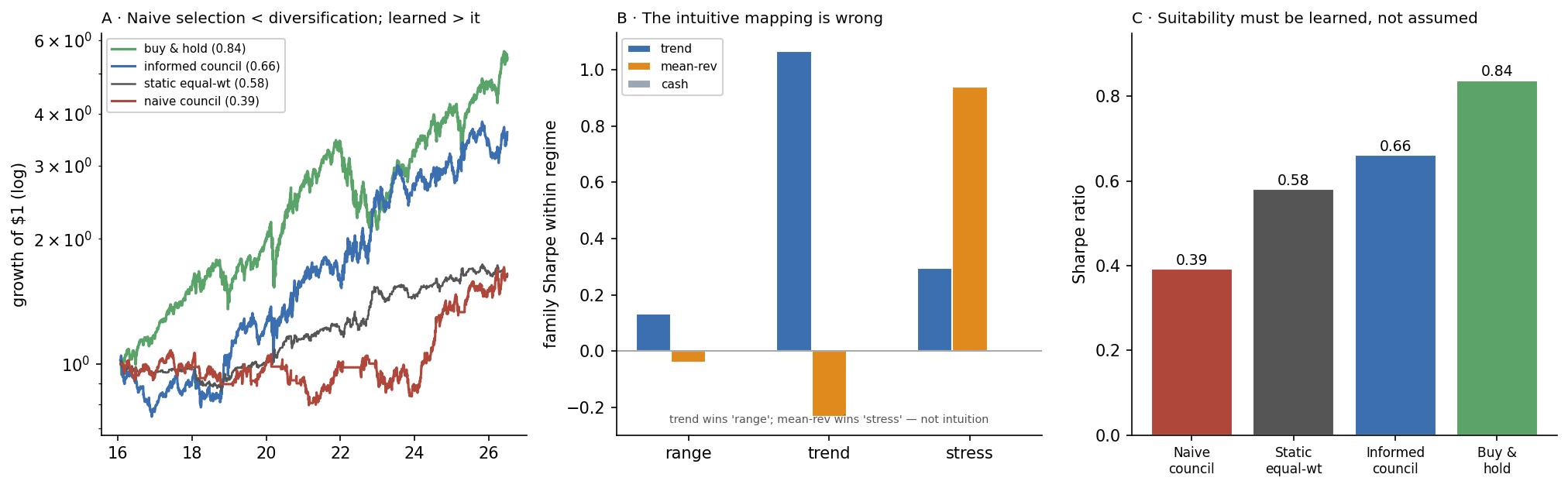
The naive council (Sharpe 0.39) is beaten by simply diversifying across the three families (0.58), and both are dwarfed by buy-and-hold (0.84). Regime-conditioned selection, done on intuition, does not just fail to add value — it destroys it relative to holding all three strategies at once.
3. Why it fails — the intuitive mapping is wrong
The middle panel is the whole lesson. Look at what each family actually earns within each regime. In the “range” regime, trend still beats mean-reversion (Sharpe +0.13 vs −0.04) — the very regime where fading is supposed to win, momentum wins. In the “stress” regime, mean-reversion is the star (+0.94) while going to cash earns zero — the regime where the mapping flees to safety is exactly where fading turbulent moves paid the most. The intuitive suitability mapping is contradicted by the data in two of the three regimes, and a council built on it duly routes to the wrong strategy most of the time. This is the proposal’s own discipline turned on itself: do not assume the regime-to-strategy mapping — measure it.
4. Learn the mapping, and it works
Replace the intuitive mapping with the data-implied one — route each regime to the family that actually performs best in it (trend in range and trend regimes, mean-reversion in stress) — and the informed council jumps to Sharpe 0.66, beating static diversification (0.58) and lifting annual return to 14.9%. So regime-conditioned selection can add value over diversification — H5 is not dead — but its entire benefit lives in getting the suitability right, which means learning it from evidence, not hand-coding intuition. That is precisely the job of the layers this tier has built: the contextual bandit that learns which action suits which context, the conditional reliability of each specialist, the consensus posterior that supplies the state. The council is only as good as the learned mapping behind it. (Honestly, the informed mapping here uses full-sample per-regime performance, so it is a ceiling — a real system must learn it online, and the bandit entry shows that is itself hard when the signal is weak — but the direction is unambiguous: assumed suitability loses, learned suitability wins.)
5. The benchmark that beats everything
One number sits above all the timing strategies: buy-and-hold, at Sharpe 0.84. None of the councils, and not static diversification, beats simply holding the Nasdaq. This is not a failure of the council so much as the site’s central finding reasserting itself — the index’s drift is real and hard to beat, and strategies that trade in and out of it mostly add turnover and drawdown-avoidance, not return. The councils do control drawdown (the naive council’s −26% and static’s −15% against buy-and-hold’s −39%), which is the honest contribution: regime-conditioned selection is a risk-governance tool, not an alpha engine — exactly the positioning the proposal has taken from the start, and the same verdict the Quant Lab reached for sizing.
6. What are its strengths?
- It separates selection from prediction. By judging strategy suitability given the state, the council tests whether market-state intelligence helps choice without claiming to forecast returns — a cleaner, more defensible contribution.
- Learned selection genuinely adds value. With the data-implied mapping the council beats static diversification (0.66 vs 0.58) — regime-conditioned selection is not empty, when the mapping is right.
- It is transparent and auditable. Explicit families and an explicit mapping mean you can always read off which strategy is active and why — the control-first design the proposal requires.
- It is risk-governed by construction. Selecting the fitting family (and standing aside in stress) controls drawdown — the councils roughly halve buy-and-hold’s drawdown.
- It is the integration layer. This is where the whole architecture’s state estimate becomes an action recommendation — the point of building the specialists and the consensus in the first place.
7. What are its weaknesses?
- H5 is not free — assumed suitability loses. The headline result: an intuitive regime-to-strategy mapping underperformed simple diversification (0.39 vs 0.58). Getting the mapping wrong is worse than not conditioning at all.
- The value hinges entirely on a learned mapping. And learning it online is hard precisely when the conditional signal is weak, as the contextual-bandit null showed — the informed result here is an in-sample ceiling, not a guaranteed live edge.
- It does not beat buy-and-hold. No timing council topped the index’s Sharpe; the honest contribution is drawdown control, not return — a risk tool, not alpha.
- Errors propagate. The council sits atop the entire state-estimation stack, so a misclassified regime routes to the wrong strategy — its quality is capped by the specialists and consensus beneath it.
- Strategy families are stylised. Three transparent rules are a demonstration; a real council needs richer, cost-aware strategies whose regime-dependence is itself estimated and can drift.
8. How could it apply to markets?
This is the proposal’s Layer 7, and it completes the architecture from data → specialists → calibrated evidence → consensus state → strategy suitability → deterministic risk. Its honest result is the capstone of the whole build tier and a direct vindication of the proposal’s design. A system that assumes which strategy suits which regime is worse than one that just diversifies — so the elaborate upstream machinery is not decoration, it is the only thing that makes the council work: the regime-to-strategy suitability must be learned from evidence, conditionally and honestly, which is exactly what the reliability, bandit and reconciliation layers do. And the fact that even a well-tuned council does not beat buy-and-hold on return, only on drawdown, is why the proposal targets robustness and risk-governed decision quality, not alpha. The council is where the architecture earns or fails to earn its keep — and the verdict is that it earns it as a risk-governance and selection layer built on learned suitability, not as a return-prediction engine built on intuition. With this layer, every method the proposal names is now built and tested on this site.
9. What does the Python code look like?
import numpy as np, pandas as pd

# transparent strategy families (positions set at t, act on next-day return)
pos_trend = np.sign(mom20)          # ride the trend
pos_mr    = -np.sign(r3)            # fade the last 3 days
R = {"trend": pos_trend*rf, "mean_rev": pos_mr*rf, "cash": np.zeros_like(rf)}

# real-time regime (expanding quantiles -> no look-ahead)
regime = np.where(vol20 > vol20_q80, "stress",
         np.where(np.abs(mom20)/vol20 > strength_q60, "trend", "range"))

# the council routes by a suitability mapping -- which MUST be learned, not assumed
mapping = {"range": "trend", "trend": "trend", "stress": "mean_rev"}   # data-implied, not intuitive
council = np.array([R[mapping[g]][t] for t, g in enumerate(regime)])

def sharpe(x): x = x[np.isfinite(x)]; return x.mean()/x.std()*np.sqrt(252)
# naive intuitive mapping -> 0.39 ; learned mapping -> 0.66 ; diversify-all -> 0.58 ; buy&hold -> 0.84
The council is one line of routing; the entire result turns on whether the mapping is guessed or learned.
10. How would I explain it to a supervisor?
“The strategy council is where my architecture finally acts — it takes the inferred regime and picks which strategy family to run, which is my H5. I tested it honestly with three transparent strategies — trend, mean-reversion, cash — routed by regime. The result is the most useful on the whole site. A council with the intuitive mapping, mean-revert in ranges and go to cash in stress, got a Sharpe of 0.39 — worse than just diversifying across all three, which got 0.58. When I looked at why, the intuitive mapping was empirically wrong: trend beat mean-reversion even in range regimes, and mean-reversion, not cash, was the best thing to do in stress. So I let the data set the mapping instead, and the council jumped to 0.66, beating diversification. The lesson is exactly my proposal’s thesis: regime-conditioned selection can help, but only if the suitability is learned from evidence, not assumed — which is what all my reliability, bandit and reconciliation machinery is for. And the honest ceiling: nothing beat buy-and-hold’s 0.84 on Sharpe; the councils only helped on drawdown. So this is a risk-governance and selection layer built on learned suitability, not an alpha engine built on intuition — which is precisely the risk-first case my proposal makes.”
Nasdaq daily 2015–2026. Families: trend = \operatorname{sign}(\text{20-day momentum}); mean-reversion = -\operatorname{sign}(\text{3-day return}); defensive = flat. Regime (real-time, expanding-window quantiles, ≥250-day warm-up): stress if 20-day vol > its expanding 80th pct (n=632); trend if |\text{mom}_{20}|/\text{vol}_{20} > expanding 60th pct (n=952); range otherwise (n=1,038). Positions at t act on r_{t+1} (no look-ahead). Sharpe / ann. return / max drawdown: naive council (range→mean-rev, trend→trend, stress→cash) 0.39 / 5.9% / −26.2%; static equal-weight 0.58 / 5.2% / −15.2%; informed council (range→trend, trend→trend, stress→mean-rev, mapping from full-sample per-regime Sharpe — a ceiling) 0.66 / 14.9% / −28.7%; buy-and-hold 0.84 / 18.8% / −39.1%. Per-regime family Sharpe — range: trend +0.13, mean-rev −0.04; trend: +1.07, −0.23; stress: +0.30, +0.94 (cash 0 throughout). Every number was checked.